
A single moment of escalation can suddenly put your entire future on the line. Whether you’re facing a Class A misdemeanor or a high-stakes felony, the weight of an assault charge feels like a heavy burden that threatens your career, your family, and your basic freedom. You’re likely worried about the stigma of a permanent criminal record or the very real possibility of incarceration. Securing a Connecticut assault defense lawyer who understands the gravity of your situation is the first step in shifting from a position of vulnerability to one of informed strength.
We understand the anxiety that comes with deciphering the different degrees of assault and the complex Connecticut court system. My approach applies military-grade discipline and strategic advocacy to protect your rights throughout this process. This article outlines the specific penalties you face, from mandatory minimums to potential fines, and previews the diversionary programs that could lead to a dismissal of your charges. You’ll learn how a proactive plan of action can help you avoid jail time and secure the best possible outcome for your case.
Key Takeaways
- Identify the legal differences between ‘physical injury’ and ‘serious physical injury’ and how these classifications dictate the severity of your charge.
- Gain insight into tactical evidence reviews, including how body-worn camera footage and witness inconsistencies are used to challenge the prosecution’s narrative.
- Consult with a Connecticut assault defense lawyer to explore statutory justifications like self-defense and determine if your case qualifies for dismissal through diversionary programs.
- Understand the specific requirements for the Accelerated Rehabilitation program and how it serves as a strategic path to avoiding a permanent criminal record.
- Learn how a disciplined, mission-first legal approach protects your freedom by applying military-grade precision to complex civilian and military law cases.

Call For A Consultation
(860) 333-6455Table of Contents
Understanding Assault Charges under the Connecticut Penal Code
Facing a criminal charge is a high-stakes encounter that requires a disciplined, tactical response. In the state of Connecticut, assault is defined primarily by the intent to cause physical injury to another person. While the term sounds straightforward, Understanding Assault Charges under the Connecticut Penal Code involves recognizing that the law looks at both what happened and what you were thinking when it occurred. A Connecticut assault defense lawyer views the initial police report not as an absolute truth, but as a preliminary intelligence report that often contains gaps, biases, and missing context.
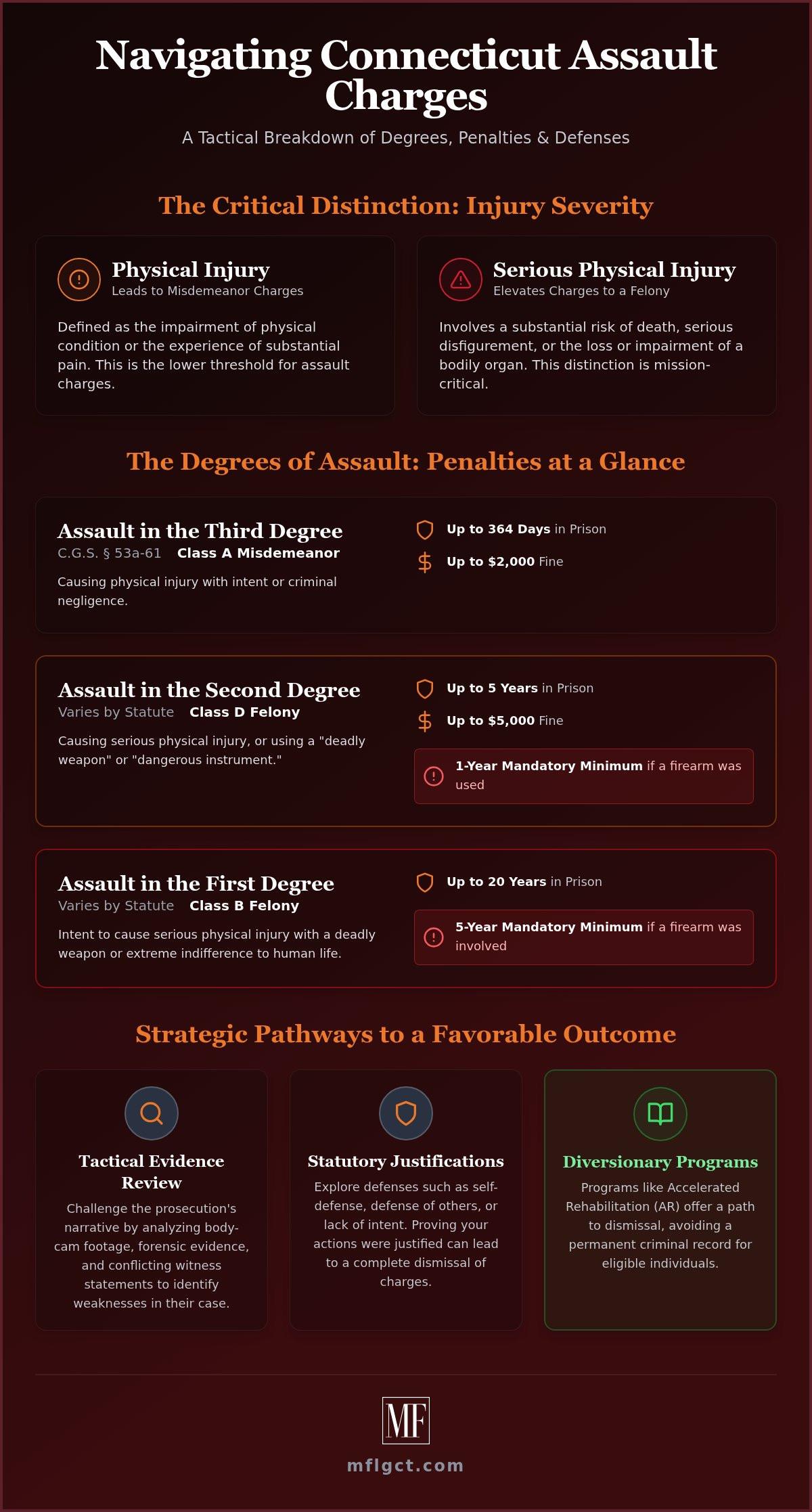
The severity of your case often hinges on the legal distinction between “physical injury” and “serious physical injury.” Under CT law, a physical injury refers to the impairment of physical condition or substantial pain. However, a “serious” injury involves a substantial risk of death, serious disfigurement, or the loss or impairment of an organ. This distinction is mission-critical; it is often the difference between a misdemeanor that stays on your record and a felony charge that carries years of prison time. A simple heated altercation can escalate into a felony if the state alleges a weapon was used or if the resulting injury meets that “serious” threshold.
Intent vs. Accidental Harm
The prosecution’s primary objective is to prove your mental state at the time of the incident. To secure a conviction for intentional assault, they must demonstrate you acted with the specific purpose of causing harm. If the state cannot prove intent, they may pivot to “reckless endangerment,” which involves disregarding a substantial and unjustifiable risk. Many assault arrests stem from genuine accidents or chaotic situations where actions are misconstrued as intentional acts. We work to isolate these moments of confusion to show that the legal requirement for “intent” simply was not met.
The Role of the Prosecution in CT Courts
In jurisdictions like the New Haven or Groton Superior Courts, the prosecutor bears the heavy burden of proving every element of the crime beyond a reasonable doubt. This is the highest standard in our legal system. A skilled Connecticut assault defense lawyer identifies the “narrative gaps” in the prosecution’s story, such as conflicting witness accounts or a lack of forensic evidence. By applying pressure to these weak points, we force the state to reconcile the inconsistencies in their case. Our goal is to move you from a state of uncertainty to a position of informed strength through a calculated, persistent defense strategy.

Call For A Consultation
(860) 333-6455The Degrees of Assault: From Misdemeanors to Felonies
In the legal arena, the severity of your charge is determined by the specific facts on the ground. Connecticut law tiers assault charges based on the intent of the actor, the level of injury sustained, and whether a weapon was involved. Understanding these distinctions is vital because the strategic approach for a misdemeanor differs significantly from the defense required for a high-level felony. A Connecticut assault defense lawyer must analyze the prosecution’s evidence to determine if they’ve overcharged your case based on the actual events.
- Assault in the Third Degree: Classified under Connecticut General Statutes § 53a-61, this is a Class A Misdemeanor. It involves causing physical injury with intent or criminal negligence. Penalties include up to 364 days in prison and a fine of up to $2,000.
- Assault in the Second Degree: This is a Class D Felony. It typically involves the use of a “deadly weapon” or “dangerous instrument” other than a firearm, or causing serious physical injury. Conviction can result in up to 5 years in prison and a $5,000 fine. If a firearm was used, a one-year mandatory minimum sentence applies.
- Assault in the First Degree: A Class B Felony, this is the most serious assault charge. It involves intent to cause serious physical injury with a deadly weapon or under circumstances showing extreme indifference to human life. Penalties range from 1 to 20 years in prison, with a mandatory minimum of 5 years if a firearm was involved.
The stakes are high. If you’re facing these tiers of prosecution, you need a battle-tested ally to review the facts. You can contact our team to begin building a disciplined defense strategy today.
Assault on Public Safety or Elderly Personnel
Connecticut law provides enhanced protections for specific groups, including police officers, emergency room personnel, and individuals over age 60. An assault on a “protected” class often triggers mandatory minimum sentences and carries a significant amount of political pressure from the state. Prosecutors are frequently less willing to negotiate these cases due to public scrutiny. These charges require a specialized, disciplined defense approach that focuses on procedural errors and the specific statutory requirements that the state must meet to prove the victim fell within a protected category.
Collateral Consequences: Career and Education
The damage of a conviction extends far beyond the courtroom. For professionals, an assault record can lead to the immediate suspension or revocation of state licenses. Students face a dual-threat: criminal prosecution and university disciplinary hearings that can result in expulsion. If you are a student or parent dealing with these academic hurdles, our Education Law Attorney Connecticut services provide the strategic advocacy needed to protect your future. Additionally, for service members stationed near the Groton Sub Base, a civilian assault charge can trigger a separate military investigation, potentially ending a career in the armed forces. We understand these multi-layered implications and fight to protect your reputation in every forum.

Call For A Consultation
(860) 333-6455Analyzing the Prosecution’s Evidence: A Tactical Review
A successful defense is not a passive waiting game. It is a calculated investigation into the prosecution’s case file to identify tactical advantages. While the state presents its evidence as a finished product, a seasoned Connecticut assault defense lawyer knows it is merely a collection of reports that must be scrutinized for errors. We start by examining the intelligence gathered at the scene, specifically body-worn camera (BWC) footage. These recordings often reveal procedural lapses, such as an officer failing to read Miranda rights or using leading questions that taint a witness’s immediate recollection of events.
We also prioritize the review of forensic medical records. As discussed in previous sections, the distinction between degrees of assault often rests on the specific severity of the injury. We analyze these documents to determine if the state’s classification of serious physical injury is medically sound or if they’re overreaching to secure a harsher penalty. Our independent investigation includes a site visit to the incident location to evaluate lighting, line-of-sight, and physical obstructions that police might have overlooked in their initial report. This thoroughness allows us to build a defense based on hard data rather than police assumptions.
The Power of Video Evidence
Surveillance footage from nearby businesses or bystander cell phone video can be the turning point in your case. These recordings often provide a neutral perspective that contradicts the narrow narrative found in a police report. However, digital evidence is perishable. We move with a sense of urgency to secure this footage before it is overwritten or deleted by automated systems. By syncing multiple video angles, we establish a precise timeline of events that can prove self-defense or show that you weren’t the primary aggressor in a chaotic situation.
Challenging Witness Credibility
Witnesses are human, and their testimony is frequently shaped by bias, confusion, or personal motives. we use the discovery process to identify these mission-critical flaws. Through strategic depositions and rigorous cross-examination in Connecticut courts, we expose inconsistencies between what a witness told the police and the physical facts of the case. Disciplined advocacy means we don’t just accept a statement at face value; we hunt for the truth hidden behind conflicting stories. When a Connecticut assault defense lawyer uncovers a witness’s motive to lie, it creates the reasonable doubt necessary to protect your freedom.
Strategic Defenses and Diversionary Programs in Connecticut
Once we have analyzed the evidence and identified the narrative gaps, the next phase of our mission is determining the most effective path to a dismissal or reduction of charges. A Connecticut assault defense lawyer must evaluate whether your case qualifies for a statutory justification or a pretrial diversionary program. In many instances, the goal is not just to win at trial but to ensure your record remains clean through disciplined negotiation and the strategic application of Connecticut law.
One powerful tool in our arsenal is the “De Minimis” argument. This strategy is used when the alleged conduct is so minor that it does not warrant the gravity of a criminal prosecution. For example, if a physical contact resulted in no actual injury and occurred during a chaotic but non-threatening event, we can petition the court to dismiss the case because the harm was trivial. Additionally, we frequently utilize “defense of others” or “defense of property” as legal justifications. If you acted to prevent an imminent assault on a family member or to stop a theft, Connecticut law recognizes your right to use reasonable force.
Qualifying for Accelerated Rehabilitation (AR)
The Accelerated Rehabilitation program is a pretrial diversionary option that can lead to the total erasure of your criminal record. To be eligible as of August 2026, you must have no prior criminal convictions and cannot have used the program within the last 10 years. It is important to note that Class A and Class B felonies are generally excluded from AR. During the application process, the court will consider the nature of the offense and the victim’s position. If the judge grants the program, you will be placed on a period of probation; successful completion results in the charges being dismissed and the records being wiped clean. If you believe you qualify for this path, you should request a case evaluation to discuss your eligibility.
The Self-Defense Doctrine in CT
Connecticut General Statute § 53a-19 governs the use of physical force in self-defense. Unlike “stand your ground” states, Connecticut generally imposes a “duty to retreat” if you can do so in complete safety. However, this duty does not apply if you are in your own home or place of work. To successfully assert this defense, we must prove you held a “reasonable belief” that the other person was about to use imminent physical force against you. Justification serves as a complete defense to assault charges, meaning that if the jury finds your actions were legally justified, you cannot be convicted. A Connecticut assault defense lawyer builds this defense by meticulously reconstructing the scene to show that your actions were a necessary response to a perceived threat.
The Mission Focus Approach: Disciplined Advocacy for Your Case
Legal defense is often described as a battle, but at Mission Focus Legal Group, we treat it as a disciplined operation. Led by USMC Reserve Major Keith Anthony, our firm approaches every case with the same level of preparation and strategic pressure required in high-stakes military environments. When you hire a Connecticut assault defense lawyer from our team, you aren’t just getting an advocate; you’re gaining a partner who prioritizes your mission above all else. We understand that your freedom and reputation are the primary objectives. This mission-first mentality means we don’t settle for the path of least resistance. We hunt for the flaws in the prosecution’s narrative that others might miss.
Transparency is the cornerstone of our communication. You’ll never be left wondering about the status of your case or the next tactical move. We provide clear, direct guidance that humanizes the technical complexities of the law, ensuring you feel seen and supported rather than lectured. Whether your case is in Groton, New Haven, or Norwich, we bring a steady, calming presence to an otherwise chaotic process. Our goal is to carry your legal burdens so you can focus on reclaiming your life.
Why Experience Matters in CT Criminal Courts
Success in the courtroom often depends on understanding the local nuances of specific jurisdictions. Our team has over 10 years of experience appearing in courts across the state, including Norwich, Branford, and Middletown. This local knowledge, combined with Keith Anthony’s background as a former Judge Advocate, allows us to provide a unique advantage to our clients. We possess specialized expertise in both civilian and military legal systems, which is invaluable for service members or professionals whose careers depend on a clean record. Our commitment to thorough preparation and unflinching advocacy ensures that no detail is overlooked in your defense.
Taking the First Step Toward Your Defense
The most critical window for your defense is the period immediately following an arrest. Early intervention allows a Connecticut assault defense lawyer to secure perishable evidence, such as surveillance footage, and interview witnesses while their memories are still fresh. Waiting even a few days can result in the loss of mission-critical data that could have exonerated you. During your initial strategic consultation, we will conduct a preliminary review of the charges against you and begin outlining a plan of action. We focus on identifying the most direct route to a reduction or dismissal of your charges. Don’t leave your future to chance or delay your response. Contact Mission Focus Legal Group today to begin your defense mission.
Initiate Your Defense Mission Today
An assault charge doesn’t have to define your future. By understanding the specific degrees of the Connecticut penal code and utilizing tactical evidence reviews, you can shift the momentum of your case. We’ve explored how diversionary programs and statutory justifications like self-defense provide viable paths toward a dismissal. Every second counts when your reputation and freedom are under fire. Securing a dedicated Connecticut assault defense lawyer ensures that your case is handled with the precision and discipline it deserves.
Led by USMC Reserve Major Keith Anthony, a former Judge Advocate, Mission Focus Legal Group has served the Connecticut community for over 10 years. We bring battle-tested experience to every high-stakes defense. You don’t have to carry this burden alone. Our team is ready to provide the steady guidance and unflinching advocacy needed to protect your rights in and out of the courtroom. Secure Your Strategic Defense Consultation with Mission Focus Legal Group. You have the power to change the trajectory of your case starting now.
Frequently Asked Questions
What is the difference between a felony and a misdemeanor assault in CT?
The classification depends on the level of injury and the intent behind the act. Misdemeanor assault, such as Assault in the Third Degree, typically involves physical injury caused by intent or criminal negligence. Felonies occur when there is serious physical injury or the use of a deadly weapon. A Connecticut assault defense lawyer evaluates the state’s evidence to determine if the charges accurately reflect the medical reality of the injuries sustained.
Can I be charged with assault if I was only defending myself?
You can absolutely be charged even if you were acting in self-defense. Police often make arrests based on the immediate aftermath of a fight rather than a full legal analysis of who started it. In Connecticut, self-defense is a justification that your attorney must prove in court. We work to establish that you had a reasonable belief of imminent harm and no safe way to retreat before using force.
What is the Accelerated Rehabilitation (AR) program, and do I qualify?
Accelerated Rehabilitation is a pretrial program for individuals with no prior criminal record or certain previous diversionary uses. If you’re charged with a misdemeanor or a less serious felony, you may be eligible to have your case dismissed after a period of probation. Successful completion results in the erasure of your record. We guide you through the application process and advocate for your entry into the program during the required court hearings.
Will an assault charge show up on my background check for a job?
An assault charge will appear on a background check as a pending case or a conviction unless it’s dismissed and erased. Even an arrest without a conviction can sometimes be visible to employers depending on the depth of their search. This is why our mission focuses on securing a dismissal or entry into a diversionary program. Once a case is dismissed through a program like AR, the records are legally erased.
What should I do if the police want to question me about an assault?
If the police want to question you, politely decline to speak and ask for an attorney immediately. Anything you say can be used to build the prosecution’s case, even if you’re trying to explain your side. You have a constitutional right to remain silent and a right to counsel. Contacting a Connecticut assault defense lawyer before making any statements is the most effective way to protect your rights and avoid self-incrimination.
Can an assault charge be dropped if the victim doesn’t want to press charges?
Only the state prosecutor has the authority to drop a criminal charge; the victim doesn’t “press” or “drop” charges in Connecticut. While a victim’s desire not to proceed is a factor the prosecutor considers, it doesn’t guarantee a dismissal. The state may continue the case if they believe they have enough evidence, such as 911 calls or body camera footage. We negotiate with prosecutors to highlight the victim’s stance.
How much does a Connecticut assault defense lawyer cost?
The cost of legal representation varies based on the complexity of the charges and the expected duration of the case. Factors such as the number of witnesses, the need for expert testimony, and whether the case goes to trial all influence the total investment. We provide a transparent breakdown of our fee structure during your initial consultation. This ensures you understand the resources required to execute a disciplined and thorough defense mission.
How long does a typical assault case take to resolve in CT courts?
A typical assault case in Connecticut can take anywhere from a few months to over a year to resolve. Misdemeanors involving diversionary programs often move faster than complex felony cases headed for trial. The timeline depends on the court’s schedule, the speed of the discovery process, and the complexity of the negotiations. We maintain a steady momentum throughout the process to ensure your case moves toward a resolution without unnecessary delays.
Call For A Consultation
(860) 333-6455