
Accepting the first settlement offer you receive isn’t a win; it’s a tactical surrender that often leaves thousands of dollars on the table. When you’re facing mounting medical bills and the stress of lost wages, the urge to take the quickest path out is understandable. However, mastering the car accident settlement timeline CT requires a disciplined, strategic approach rather than a race to the finish line. You deserve a recovery that accounts for the full scope of your injuries, not just the immediate costs.
We understand the anxiety that comes with insurance delays and the complexity of the Connecticut court system. This guide provides a phase-by-phase breakdown of the legal process, moving from initial medical stabilization to high-stakes negotiations. We’ll explore why insurance companies use delay tactics and how those maneuvers are countered with precision. You’ll gain a clear roadmap of the settlement phases and the confidence to know your case is being handled with the rigor it deserves. By understanding the strategic timing behind each move, you can transition from a state of vulnerability to a position of informed strength.
Key Takeaways
- Understand that while simple claims may resolve in months, a complex car accident settlement timeline CT can extend beyond two years to ensure full compensation for serious injuries.
- Learn why reaching Maximum Medical Improvement (MMI) is a non-negotiable phase that prevents you from settling for less than your long-term medical needs require.
- Discover how a professional “Demand Package” acts as a strategic mission brief to hold insurance carriers accountable during the initial negotiation window.
- Gain a clear roadmap of the litigation process in the CT Superior Court, including how the discovery phase uncovers critical evidence to strengthen your position.
- See how applying a disciplined, military-grade mindset to your legal strategy helps bypass insurance delays and keeps you informed throughout the recovery process.

Call For A Consultation
(860) 333-6455Table of Contents
- What is the Average Car Accident Settlement Timeline in CT?
- Phase 1: Reaching Maximum Medical Improvement (MMI)
- Phase 2: The Engagement—Negotiation with Insurance Carriers
- Phase 3: Tactical Escalation—The Litigation Timeline in CT Courts
- Strategic Advocacy: How Mission Focus Legal Group Drives Results
What is the Average Car Accident Settlement Timeline in CT?
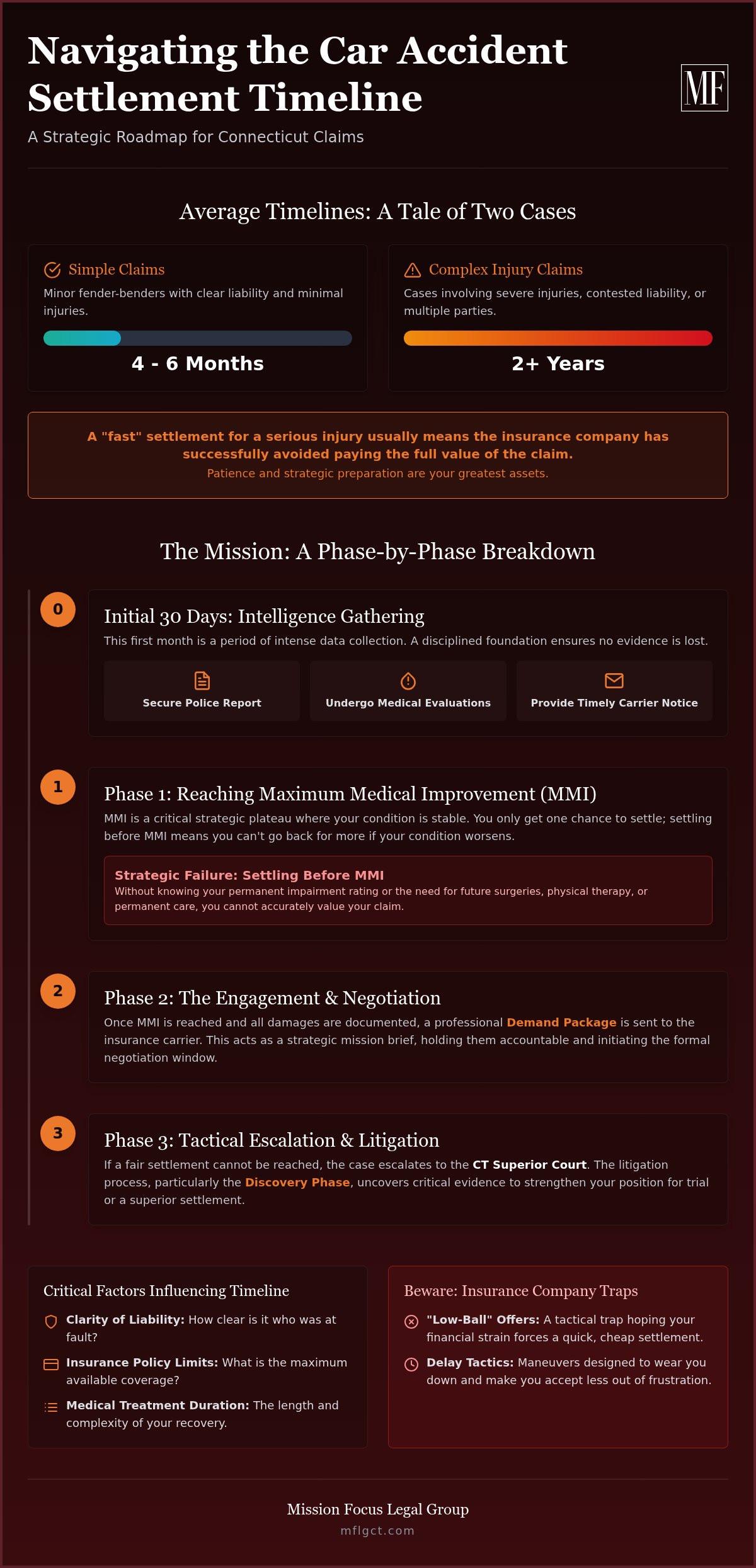
Understanding the car accident settlement timeline CT isn’t about looking at a single calendar date. It’s about assessing the specific variables of your “mission” for recovery. Most simple insurance claims in Connecticut resolve within four to six months. However, when injuries are severe or liability is contested, the timeline can easily extend to two years or more. Averages are often misleading because they blend minor fender-benders with life-altering collisions. For a serious injury victim, a “fast” settlement usually means the insurance company has successfully avoided paying the full value of the claim.
Several critical factors dictate the speed of your case. These include the clarity of liability, the available insurance policy limits, and the duration of your medical treatment. In Connecticut, the legal foundation for these claims is rooted in personal injury law, which establishes how negligence leads to liability. Additionally, state law requires drivers to report any accident involving more than $1,000 in property damage. This threshold often serves as the formal starting gun for the claim process, signaling to insurers that a significant event has occurred.
The Initial 30 Days: Intelligence Gathering
The first month is a period of intense data collection. We treat this phase as an intelligence-gathering mission. You must secure the official police report and undergo comprehensive medical evaluations to document the full extent of your physical damage. Connecticut also has specific notice requirements for certain types of insurance carriers. Failing to provide timely notice can jeopardize your ability to recover funds later. Establishing this foundation with military-grade discipline ensures that no piece of evidence is lost to time or poor documentation.
Defining the ‘Tactical Timeline’ for Your Case
It’s vital to distinguish between property damage and personal injury settlements. Property damage claims usually move quickly because the costs are objective and easily calculated. Personal injury claims are different. They require patience. If you were involved in a complex multi-car pileup on I-95 in New Haven, the car accident settlement timeline CT will naturally expand as investigators determine the fault of every driver involved.
Insurance adjusters often use early “low-ball” offers as a tactical trap. They hope the financial strain of your lost wages will force you to accept a fraction of what you’re owed. We resist these maneuvers. Our strategy is built on persistence and thorough preparation, ensuring that we move at the speed of justice, not the speed of an insurance company’s profit margin.

Call For A Consultation
(860) 333-6455Phase 1: Reaching Maximum Medical Improvement (MMI)
MMI represents a critical strategic plateau in your recovery. It’s the point where your condition cannot be further improved by medical treatment. In the context of a car accident settlement timeline CT, rushing to settle before reaching MMI is a strategic failure that leaves significant money on the table. Without knowing if you’ll need future surgeries, physical therapy, or permanent home care, you cannot accurately value your claim. You only get one chance to settle; if your condition worsens after the papers are signed, you cannot go back for more.
Long-term injuries like traumatic brain injuries (TBI) or spinal damage fundamentally shift the car accident settlement timeline CT because these conditions require months of observation to determine a permanent impairment rating. We work with Connecticut medical experts to document these ratings with precision, ensuring your demand reflects the reality of your future. For lower-value property claims, you might look into Connecticut’s small claims court process, but for serious bodily injury, waiting for MMI is non-negotiable for a successful outcome.
The Medical Evidence Trail
Victory in a personal injury case is built on a foundation of objective data. We gather exhaustive records from local institutions like Yale New Haven Hospital or Lawrence + Memorial to construct your medical history. Diagnostic imaging, such as MRIs and CT scans, is vital for proving “invisible” injuries that insurance adjusters try to dismiss. MMI is the ‘green light’ for calculating future medical costs because it provides the finality needed for an expert to project your lifelong needs.
Managing the ‘Treatment Gap’ Risk
Insurance adjusters are trained to hunt for “treatment gaps” in your medical history. If you skip a physical therapy session or wait two weeks to see a specialist, they will use that delay to argue that your injuries aren’t serious. Maintaining discipline is a legal requirement in our eyes. You must follow every doctor’s order to the letter to protect the integrity of your claim. If you have pre-existing conditions, we proactively address them during the medical investigation phase to prevent the insurer from blaming your current pain on old injuries. If you’re feeling overwhelmed by the paperwork, our team can carry that burden for you while you focus on healing.

Call For A Consultation
(860) 333-6455Phase 2: The Engagement—Negotiation with Insurance Carriers
After reaching MMI, the defensive phase of your recovery ends and the strategic offensive begins. This stage of the car accident settlement timeline CT centers on the “Demand Package.” Think of this document as a comprehensive mission brief. It’s not just a polite request for payment; it’s a formal, evidence-backed presentation that leaves no room for ambiguity. Once this package is delivered to the adjuster, the clock starts ticking. Connecticut insurance carriers typically respond within 30 to 45 days, though major carriers often use this window to deploy stall tactics, hoping your financial resolve will weaken as household bills accumulate.
Negotiation is a test of persistence. We monitor every day of that response window to ensure the carrier doesn’t bury your file under a mountain of bureaucracy. If the insurer fails to engage in good faith, we prepare for escalation. A settlement is only acceptable if it meets the “Final Offer” threshold, which is the point where the compensation accurately reflects your total losses. If the insurer remains below this line, the mission shifts from negotiation to litigation.
The Art of the Demand Letter
The Demand Letter serves as the core of your engagement. It must include an exhaustive accounting of medical expenses, verified lost wages, and a meticulously calculated valuation of pain and suffering. We apply military-grade precision to these “non-economic” damages, using established formulas to ensure your human experience is translated into a formidable legal argument. You must also understand the distinction between settling with your own insurance through Personal Injury Protection (PIP) versus pursuing the at-fault party’s liability policy. These are separate tactical maneuvers that require distinct documentation and timing.
Counter-Offers and Tactical Leverage
The initial response from an insurance adjuster is rarely their best offer. We analyze every counter-offer to determine if the carrier is negotiating fairly or simply testing your patience. Under Connecticut’s modified comparative negligence laws, insurers will often try to shift a percentage of fault onto you to reduce their payout. We use the medical and forensic evidence gathered earlier to defend your position and maintain maximum tactical leverage. When a carrier refuses to move past an unreasonable offer, we recognize the impasse immediately. We don’t waste months in circular arguments; when the car accident settlement timeline CT stalls due to insurer stubbornness, we move to file a formal complaint in the CT Superior Court.
Phase 3: Tactical Escalation—The Litigation Timeline in CT Courts
When an insurance carrier refuses to meet our valuation during negotiations, we transition from dialogue to tactical escalation. This phase begins with filing a formal complaint in the Connecticut Superior Court. We operate under the strict procedural mandates of the Connecticut Practice Book, which serves as the operational manual for all civil litigation in the state. Filing a lawsuit isn’t just a paperwork exercise; it’s a decisive move that signals to the adversary that we’re prepared for a full-scale legal engagement. This transition often shifts the car accident settlement timeline CT from a voluntary exchange into a court-mandated schedule with firm deadlines.
Litigation is a marathon, not a sprint. While many cases still settle before reaching a jury, the court’s involvement adds layers of complexity, such as mandatory pre-trial conferences and mediation sessions. These are high-stakes environments where a judge or neutral mediator attempts to resolve the dispute. If these sessions don’t produce a fair result, the case proceeds toward a trial. Trial is the final and most time-consuming phase of the mission, but the rigorous preparation we conduct in the preceding months ensures we enter the courtroom with a formidable advantage.
The Discovery Process: Digging for Truth
Discovery is the intelligence-gathering heart of a lawsuit. It’s an intensive period where both sides exchange evidence through written interrogatories and oral depositions. During a deposition, you’ll provide testimony under oath. We’ll be there to protect your story and prevent defense counsel from twisting your words. This phase also involves mobilizing expert witnesses, such as medical specialists and accident reconstruction engineers, to provide objective proof of your damages. In judicial districts like New Haven or Groton, the discovery phase typically lasts between 6 and 12 months, depending on the volume of evidence and the court’s current backlog.
Connecticut’s Statute of Limitations
Time is a finite resource in any legal mission. Under Connecticut General Statutes Section 52-584, you have a strict two-year deadline from the date of the accident to file a personal injury lawsuit. If you miss this window, your right to seek compensation is permanently extinguished. While there are narrow exceptions for injuries that weren’t immediately discoverable, relying on them is a dangerous gamble. We prefer a proactive strategy. Filing your claim well before the deadline shows the insurer that you’re disciplined and trial-ready. If you’re concerned about how much time you have left, contact our team immediately to secure your right to recovery.
Strategic Advocacy: How Mission Focus Legal Group Drives Results
Navigating the car accident settlement timeline CT requires more than just legal knowledge. It demands a tactical mindset that anticipates insurer obstacles before they arise. At Mission Focus Legal Group, we don’t just manage cases. We lead missions. Applying military-grade discipline means we don’t wait for the insurance company to dictate the pace. We set the tempo. In the Connecticut legal system, insurance carriers often rely on the fact that victims are overwhelmed and under-informed. We disrupt that dynamic by providing a steady, calming presence backed by aggressive legal action. Our strategy is built on persistence, tracking every deadline with the same attention to detail required in high-stakes military reconnaissance.
Our local expertise across the Connecticut shoreline, from the busy streets of New Haven to the community in Groton, gives us a distinct home-field advantage. With over 10 years of service in Connecticut, we understand the local courts and the specific tactics used by regional insurance offices. You’ll never be left wondering where your case stands. We prioritize clear, direct communication so you can focus on your physical recovery while we handle the heavy lifting of your legal defense. We treat every file as if it’s heading to a jury from day one, which forces insurance adjusters to take your claim seriously.
The Keith Anthony Difference: Military Discipline in Law
Led by Marine Corps Reserve Major Keith Anthony, our firm applies the same rigor found in military operations to civil litigation. Keith Anthony’s background isn’t just a detail on a resume; it’s the DNA of our firm. As a former Judge Advocate (JAG), he understands how to navigate complex systems with precision and speed. We handle the difficult “flank” of legal paperwork and insurance red tape, protecting you from the stress of the process. This disciplined research and attention to detail extend across all our practice areas, including our work as an Education Law Attorney Connecticut. Whether we are fighting for a student’s rights or an accident victim’s compensation, the mission remains the same: aggressive advocacy and total transparency.
Taking the Next Step: Your Free Strategy Session
Your recovery journey shouldn’t be a solitary struggle. During your initial strategy session, we’ll review the specifics of your accident, identify the key variables affecting your car accident settlement timeline CT, and outline a clear path forward. We operate on a no-fee guarantee. You won’t pay us a dime unless we successfully recover compensation for you. This aligns our goals completely with yours. We are your battle-tested allies, ready to carry the burden of litigation so you can reclaim your life and your peace of mind. Contact Mission Focus Legal Group today to start your recovery mission.
Take Command of Your Recovery Mission
You’ve seen that the car accident settlement timeline CT is not a passive waiting game. It’s a series of calculated maneuvers. From reaching Maximum Medical Improvement to navigating the rigorous discovery phase in Connecticut courts, every step requires precision to ensure you aren’t forced into a low-ball settlement. Accepting an early offer often means leaving your future financial security to chance. We don’t believe in chance; we believe in strategy.
Mission Focus Legal Group, led by Attorney Keith Anthony, a U.S. Marine Corps Reserve Major, brings over 10 years of aggressive advocacy to families across the state. Our expertise in personal injury, military, and education law ensures your case is handled with the high-stakes authority it deserves. We’re ready to carry your burden and fight for the results you need to move forward. It’s time to transition from a state of uncertainty to a position of informed strength. Secure Your Strategic Advantage—Schedule Your Free Consultation today. You’ve carried this weight long enough; let a disciplined protector lead the way to the justice you deserve.
Frequently Asked Questions
How long does a car accident settlement take in CT if the other driver is clearly at fault?
Clear fault does not always result in a rapid payout. Even when liability is obvious, the car accident settlement timeline CT is still dictated by the duration of your medical recovery. Most clear-cut cases resolve in 6 to 18 months, as we must wait until you reach Maximum Medical Improvement to value the claim accurately. Insurance companies often use this time to protect their own interests, requiring a disciplined approach to keep the process moving.
Why is my car accident settlement taking so long in Connecticut?
Delays often stem from insurance adjusters using stall tactics or waiting for exhaustive medical records to be processed. If your case involves complex injuries or multiple vehicles, the investigation phase takes longer to ensure every detail is documented. Additionally, significant court backlogs in districts like New Haven can add months to the timeline if a lawsuit has been filed. We monitor these delays closely to ensure your case doesn’t stall unnecessarily.
Can I get a settlement check before I finish my medical treatment?
You can technically settle at any time, but doing so is a tactical error. Settling before you finish treatment prevents you from seeking compensation for future complications or surgeries. Once you sign a release, your mission for recovery is legally over. You cannot go back for more money if your condition worsens, which is why we advise waiting until your medical status is fully stabilized.
What is the average car accident settlement amount in Connecticut?
Settlement amounts vary based on the specific facts of your mission. Your recovery is calculated by combining objective medical bills and lost wages with non-economic damages like pain and suffering. Because every injury is different, focusing on an average figure is often misleading. We focus on the maximum value your specific injuries and lifestyle impacts require for a full recovery.
Do I have to go to court to get a car accident settlement in CT?
Most car accident claims settle through negotiation without ever seeing a courtroom. However, we prepare every case as if it is going to trial from the first day. This disciplined preparation often forces the insurance company to offer a fair settlement to avoid the risk of a jury verdict. If the insurer refuses to be reasonable, we are ready to escalate the matter to the Superior Court.
How does the CT Statute of Limitations affect my settlement timeline?
The two-year statute of limitations acts as a hard ceiling on your car accident settlement timeline CT. You must file your lawsuit within two years of the crash or lose your right to recover entirely. Starting your claim early provides more tactical leverage, as it gives us ample time to negotiate before the threat of the filing deadline becomes a factor.
Will hiring a lawyer speed up my car accident settlement?
A lawyer speeds up the process by preventing the insurance company from ignoring your claim or burying it in red tape. We apply a mission-focused mindset to hold adjusters to strict deadlines and ensure all evidence is filed accurately the first time. This proactive defense forces the insurance carrier to engage with your case rather than letting it sit on a desk. Whether you are dealing with an insurance company after a crash or seeking assistance from Airflix for a flight disruption, professional advocacy ensures your rights are respected and your claims are prioritized.
What happens to my settlement if I was partially at fault for the accident?
You can still recover compensation if you are partially at fault, provided your responsibility is 50% or less. Under Connecticut’s modified comparative negligence rules, your final check is reduced by your percentage of fault. For example, if you are found 10% responsible for a crash, you will receive 90% of the total damages awarded. We fight to minimize your fault percentage to maximize your final recovery.
Call For A Consultation
(860) 333-6455