
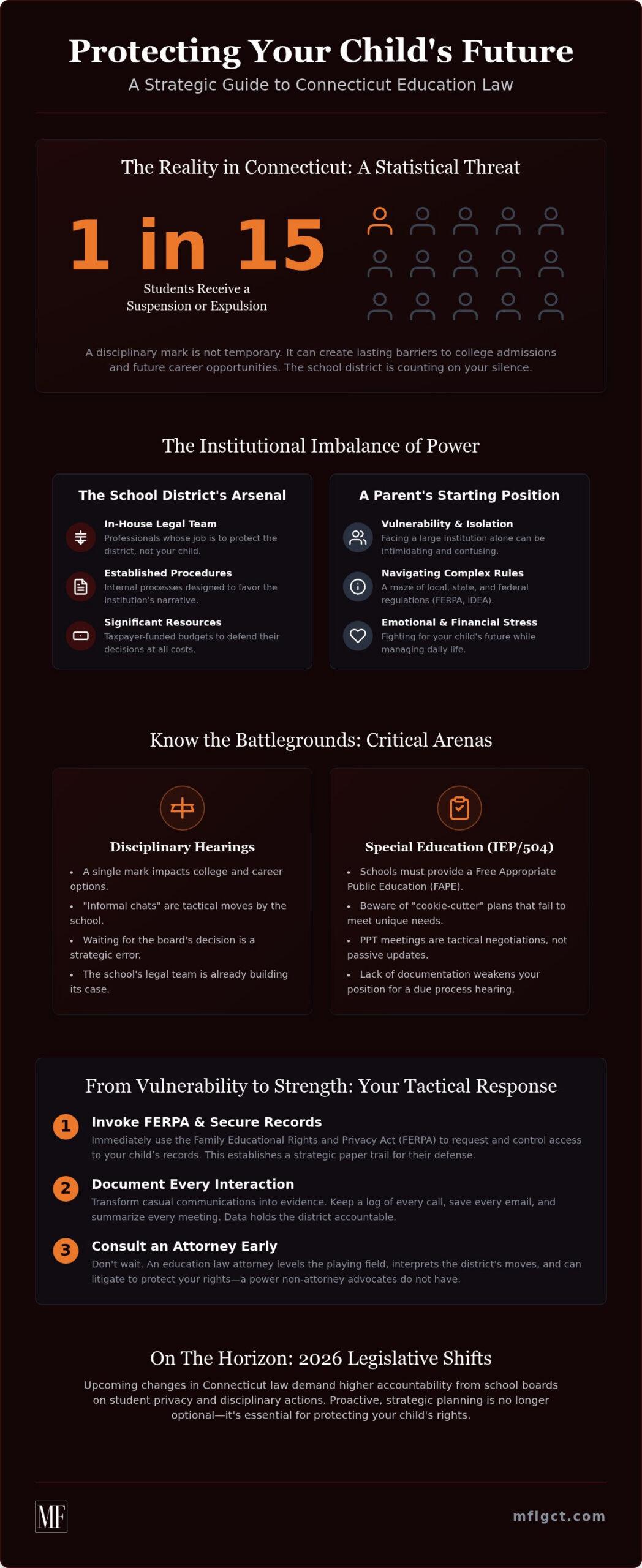
What if the school district’s legal team isn’t actually unbeatable, but simply counting on your silence? With approximately 1 in 15 Connecticut students receiving a suspension or expulsion, the threat to a child’s academic record is a statistical reality that many families face without proper support. When you’re dealing with institutional bullying or the confusion of a PPT meeting, the system can feel rigged. Securing a battle-tested education law attorney Connecticut families rely on changes the dynamic. It transforms a position of vulnerability into one of informed, strategic strength.
We agree that no parent should feel intimidated by the very institution meant to educate their child. This guide will show you how to navigate the complexities of special education laws and disciplinary hearings with a disciplined, mission-driven strategy. We’ll preview the latest 2026 regulatory shifts and explain how to ensure your child receives a legally compliant IEP or 504 plan. Your child’s future career and college prospects are the priority, and we’re here to protect them.
Key Takeaways
- Understand why 2026 legislative shifts in Connecticut require school boards to meet higher accountability standards for student privacy and disciplinary actions.
- Learn why entering a Planning and Placement Team (PPT) meeting without a tactical plan can compromise your child’s access to vital special education services.
- Discover how an education law attorney Connecticut parents rely on can level the playing field against school districts that use their legal resources to pressure families.
- Identify immediate tactical steps for responding to disciplinary calls, including using FERPA to establish a strategic paper trail for your child’s defense.
- Gain insight into how military-grade discipline and strategic advocacy protect a student’s academic record and future career opportunities from institutional overreach.
Call For A Consultation
(860) 333-6455Table of Contents
The High Stakes of Education Law in Connecticut
Education law isn’t just a set of rules. It’s a complex network of local, state, and federal regulations that define the boundaries of student rights and school board authority. In Connecticut, 2026 represents a turning point for administrative accountability. Recent amendments to the Teacher Tenure Act and stricter standards for early-grade discipline mean that the stakes for every board decision have never been higher. For a student, a single disciplinary mark can ripple through their entire future. It’s not just about a temporary suspension; it’s about how that record appears to a college admissions officer or a high-security employer years down the line.
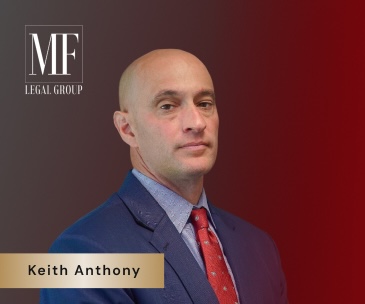
Privacy is a core pillar of this legal structure. The Family Educational Rights and Privacy Act (FERPA) ensures that student records remain confidential, yet schools often overstep these bounds during internal investigations. At Mission Focus Legal Group, we don’t treat these as mere administrative hurdles. Led by Keith Anthony, a Marine Corps Reserve Major and former JAG, we approach every case as a mission. Our objective is to secure your child’s academic future through disciplined, strategic advocacy that leaves no room for institutional overreach.
When to Consult an Education Law Attorney
Identifying red flags early is critical for a successful defense. If you receive a request for an “informal chat” regarding a disciplinary matter, or if school communications become suddenly vague and formal, these are signs of an impending legal conflict. Waiting for a final decision from the board is usually a tactical error. By that point, the school’s legal team has already built its case and documented its narrative. Hiring an education law attorney Connecticut parents trust ensures you have a licensed professional who can litigate and protect your rights, which is a significant step above what a non-attorney advocate can provide.
Connecticut’s Unique Educational Landscape
Disputes in our state are often overseen by the Connecticut State Department of Education (CSDE), but the tactical environment varies by district. Boards in New Haven or Groton often have distinct internal cultures and legal strategies compared to those in Milford or Madison. Regardless of the location, every district must adhere to the “Child Find” mandate. Under Conn. Gen. Stat. § 10-76d, Connecticut school districts have an affirmative duty to identify, locate, and evaluate all children with disabilities who may require special education and related services. When schools fail this duty, we step in to enforce the law and secure the necessary resources for your child’s success.

Call For A Consultation
(860) 333-6455Navigating Special Education, IEPs, and 504 Plans
Securing the right support for a student with special needs is a high-stakes operation that requires more than just good intentions. It demands a technical understanding of the dual framework provided by the Individuals with Disabilities Education Act (IDEA) and Section 504 of the Rehabilitation Act. While federal guidelines found in U.S. Education Law & Policy set the standard, Connecticut’s implementation adds layers of administrative complexity. Districts are legally mandated to provide a Free Appropriate Public Education (FAPE), yet they often fall short by offering “cookie-cutter” plans that fail to address a student’s unique functional or academic deficits.
The Planning and Placement Team (PPT) meeting is the primary theater where these resources are contested. You should never enter a PPT meeting without a strategic plan. School administrators often arrive with pre-drafted documents, counting on parents to passively agree to whatever is presented. We view these meetings as tactical negotiations. By identifying exactly where a district is failing to meet its obligations, an education law attorney Connecticut families trust can pivot the conversation from “what the school can afford” to “what the law requires.”
Success in these disputes often hinges on documentation. Every email, meeting minute, and progress report is a potential piece of evidence for a due process hearing. We help parents transform casual school communications into a strategic paper trail that holds the district accountable. If you feel your child’s needs are being ignored, it’s time to consult with a disciplined legal ally who understands how to enforce these protections.
The IEP Process: Securing Accommodations That Work
An Individualized Education Program (IEP) that looks functional on paper is useless if it fails in the classroom. When a school’s internal assessments are insufficient, we push for Independent Educational Evaluations (IEEs) to get an objective view of the student’s needs. Furthermore, we aggressively protect “stay-put” rights. These rights ensure that your child’s current educational placement remains unchanged while a disagreement is being resolved, preventing the school from unilaterally removing services during a dispute.
Special Considerations for Military Families in Groton
Families stationed near the Sub Base in Groton or living in Ledyard face unique educational hurdles. Frequent Permanent Change of Station (PCS) moves can disrupt a student’s service continuity, making the Interstate Compact on Educational Opportunity for Military Children a vital tool for advocacy. We ensure that a student’s Exceptional Family Member Program (EFMP) status is respected and that local Connecticut school requirements don’t become a barrier to the services your child earned at their previous duty station. Protecting the academic record of a military child requires a legal strategy that moves as fast as their next set of orders.

Call For A Consultation
(860) 333-6455Institutional Imbalance: Why Families Need Strategic Advocacy
School boards operate with a distinct home-field advantage that many parents don’t recognize until it’s too late. These boards aren’t just groups of educators; they are government entities backed by insurance-funded legal teams and administrative staff trained to protect the institution. When a dispute arises, the school’s first instinct is often self-preservation rather than student advocacy. This creates a massive power vacuum where parents feel like they are fighting a battle they’ve already lost. The psychological toll of this bureaucracy is heavy, leaving families feeling exhausted, isolated, and unheard while their child’s academic future hangs in the balance.
Many parents believe that “cooperating” or being “transparent” with administrators will lead to a faster, fairer resolution. Unfortunately, in a high-stakes legal environment, statements made without counsel can quickly become unintended admissions. These statements are often documented and used to justify exclusionary discipline or the denial of services. The Connecticut State Department of Education sets the standards for school conduct, but local boards frequently interpret these rules in ways that favor administrative convenience over student rights. Mission Focus Legal Group exists to level this playing field through disciplined, tactical litigation that forces schools to respect the law.
The School Board’s Legal Arsenal
School districts rely on a specific set of tactics to maintain control during a dispute. They often use their legal counsel to delay resolutions, hoping that the family will simply give up or that the student will graduate before a change is made. Another common strategy involves “confidential” internal investigations. These are framed as neutral fact-finding missions, but they are often used to build a narrative against a student before the parents even realize a formal case is being constructed. In urban centers like New Haven, the sheer size of the administrative hierarchy can make parents feel completely silenced during public hearings or private board meetings.
The Power of Professional Representation
The presence of a qualified education law attorney Connecticut families trust changes the atmosphere of a room instantly. It signals to the school board that the era of passive cooperation is over. By leveraging Keith Anthony’s JAG background, we navigate complex administrative hierarchies with the authority required to challenge institutional overreach. We replace the “Home Field Advantage” with a strategic defense that prioritizes your child’s rights over the school’s reputation. A strategic defense is more effective than a purely emotional plea because it forces the district to answer to statutory requirements rather than their own internal preferences. Hiring an education law attorney Connecticut parents can rely on ensures that your voice isn’t just heard, but that it actually carries legal weight in every PPT or disciplinary meeting.
Building a Defense: Steps to Take When Student Rights are Threatened
The first 24 hours after a disciplinary call determine the outcome of your case. This is the window where the school district attempts to secure admissions before you’ve even had a chance to process the situation. If you receive a call regarding a potential expulsion or a serious conduct violation, your first objective is to halt all communication. Do not allow administrators to “interview” your child without your presence or the guidance of a professional. These sessions are rarely neutral fact-finding missions; instead, they are often used to solidify a narrative that justifies harsh disciplinary action. Securing an education law attorney Connecticut parents can rely on provides an immediate shield against these high-pressure tactics.
Preparation for a disciplinary hearing requires a “Mission” mindset. You aren’t just attending a meeting; you’re defending your child’s academic future. This starts with the creation of a strategic paper trail. Under the Family Educational Rights and Privacy Act, you have a statutory right to inspect and review the complete educational record. This includes more than just report cards. It covers internal emails, disciplinary logs, and even handwritten notes from teachers or administrators. If you believe your child’s rights are being threatened, contact Mission Focus Legal Group today to begin building a disciplined defense.
Tactical Documentation and FERPA Rights
Requesting the full record often reveals what the school board is trying to hide. Many districts maintain “shadow files” or anecdotal logs that aren’t part of the official transcript but are used to influence disciplinary decisions. We use Connecticut’s specific student privacy regulations to force the disclosure of these documents. Additionally, your own contemporaneous notes are vital. A detailed, dated log of events, bullying incidents, or school neglect provides the objective timeline needed to challenge the school’s version of events. In a legal landscape where the school holds the home-field advantage, your documentation is the primary tool for leveling the playing field.
Title IX and Academic Misconduct Investigations
Title IX investigations in Connecticut high schools and colleges carry life-altering consequences. These cases, along with charges of academic misconduct, require a defense strategy that mirrors a criminal trial. The standard of evidence is often lower than in a court of law, which makes aggressive advocacy and thorough witness preparation essential. We focus on protecting the student’s reputation and future prospects by challenging biased investigations and ensuring every procedural protection is strictly enforced. When the stakes involve a permanent mark on a student’s record, a purely emotional plea isn’t enough; you need a strategic, evidence-based defense that an education law attorney Connecticut can provide.
Mission-Driven Representation: Securing Your Child’s Future
Mission Focus Legal Group operates on a simple principle: your child’s future is a mission that cannot fail. In a state where school boards wield significant institutional resources, you need an education law attorney Connecticut who brings more than just a law degree to the table. Keith Anthony’s background as a Marine Corps Reserve Major and former JAG officer provides the “X-factor” that sets our firm apart. We don’t just “handle” cases; we execute a strategic battle plan designed to dismantle administrative overreach and secure the academic resources your student deserves.
Whether we’re negotiating in a board room in New Haven or litigating a complex special education dispute in Groton, our focus remains on clear, honest communication. We believe that parents are the primary commanders of their child’s education. Our role is to provide the legal firepower and stability needed to win. This mission-driven approach ensures that every action we take is purposeful, methodical, and aimed at a decisive result. We serve families across the Connecticut shoreline, bringing a battle-tested perspective to every local dispute.
A Disciplined Approach to Litigation
Applying JAG-level scrutiny to school district evidence is what we do best. Most school administrators aren’t used to having their procedures and “confidential” logs questioned with military-grade precision. We look for the gaps in their narrative and the failures in their statutory compliance. A mission-first mindset means we don’t get bogged down in the bureaucracy; we cut through it to find the fastest path to a fair outcome. Our track record reflects a persistent commitment to standing up against institutional power when student rights are at stake. We don’t accept “good enough” when a child’s future career is on the line.
Taking the First Step: The Initial Consultation
When you call Mission Focus Legal Group, you aren’t just getting a legal consultation; you’re getting a briefing. We evaluate the mission viability of your case by looking at the facts, the documentation, and the specific goals you have for your child. We won’t give you false hope or detached legalese. Instead, we provide a steady, calming presence and a clear roadmap for the fight ahead. If the school board has threatened your child’s record or denied them necessary services, you need an education law attorney Connecticut who understands the stakes.
Contact Mission Focus Legal Group to protect your child’s rights today.
Protecting Your Child’s Academic Mission
Institutional bureaucracy is formidable, but it isn’t invincible. We’ve explored how school districts use their legal resources to maintain control and how a strategic paper trail can dismantle those advantages. By understanding your rights under FERPA and the specific requirements of Connecticut special education law, you move from a position of uncertainty to one of command. Your child’s academic record is a permanent asset that deserves a battle-tested defense. Securing the right education law attorney Connecticut families trust ensures that your voice is backed by authority and disciplined persistence.
Led by Attorney Keith Anthony, a U.S. Marine Corps Reserve Major with over 10 years of strategic legal service in Connecticut, our firm provides specialized expertise in both military and education law. We don’t just provide advice; we execute a mission to safeguard your student’s future college and career prospects. Don’t wait for the school board to make the final move. Secure Your Child’s Academic Future with Mission-Driven Advocacy today. You’ve fought for your child’s success this far; let us carry the legal burden so you can focus on their growth.
Frequently Asked Questions
What are my child’s rights during a school expulsion hearing in Connecticut?
Students in Connecticut have the right to a formal hearing before an impartial officer and the right to be represented by legal counsel. You must receive written notice of the charges and have the opportunity to present evidence, call witnesses, and cross-examine the school’s witnesses. This process is highly technical. A disciplined defense is necessary to ensure the student’s version of events is heard and their academic record remains protected from permanent damage.
Can a school district refuse to provide an IEP for my child?
A school district can refuse an IEP only if a formal evaluation determines the student doesn’t meet specific eligibility criteria under the IDEA. If the district denies services, you have the right to challenge their findings through a due process hearing or by requesting an Independent Educational Evaluation (IEE). Don’t accept a verbal denial. Force the district to provide their decision and the underlying data in writing so you can build a strategic rebuttal.
How long does a special education due process hearing take in CT?
Connecticut regulations generally require a final decision in a due process hearing within 45 days after the 30-day resolution period ends. In practice, this timeline often shifts because of the complexity of the evidence or the availability of witnesses. It’s a methodical process that requires thorough preparation. We focus on maintaining momentum during these hearings to ensure a decisive result for the student without unnecessary administrative delays.
What should I do if my child is being bullied and the school isn’t helping?
You should immediately document every incident and file a formal, written complaint with the school’s safe school climate coordinator. Connecticut law mandates that schools investigate bullying reports and notify parents of the results. If the school’s response is inadequate, it may be a violation of the student’s right to a safe learning environment. We help families escalate these matters to the state level when local administrators fail their duty.
Do I need a lawyer for a 504 Plan meeting in Connecticut?
You don’t legally need a lawyer for a 504 meeting, but having one is a strategic advantage when a district is being uncooperative. An education law attorney Connecticut families rely on ensures that accommodations are specific, measurable, and legally enforceable. Without professional oversight, 504 plans often become vague documents that schools can easily ignore. We provide the tactical guidance needed to turn a weak plan into a functional shield for your child.
Can a military family get expedited education services when moving to Groton?
Military families are protected by the Interstate Compact on Educational Opportunity for Military Children, which requires schools in Groton and across CT to provide “comparable services” immediately. This prevents a lapse in support during a PCS move. The new school must honor the existing IEP or 504 plan while they conduct their own evaluations. Our firm uses Keith Anthony’s military background to ensure these protections are strictly enforced for service members and their children.
What is the difference between an educational advocate and an education attorney?
The main difference is that an education attorney is licensed to provide legal advice and represent you in formal litigation or due process hearings. While an advocate can offer support during meetings, they lack the authority to challenge a school board in court. Hiring an education law attorney Connecticut parents trust provides a level of strategic protection and accountability that a non-attorney advocate simply cannot match during high-stakes disputes.
How does Title IX affect high school students in Connecticut?
Title IX protects students from sex-based discrimination, which includes sexual harassment, assault, and unfair treatment in athletic programs. In Connecticut high schools, a Title IX investigation is a formal, high-stakes process that can lead to expulsion and a permanent mark on a student’s transcript. These cases require a disciplined, evidence-based defense to ensure the investigation is impartial and that the student’s future college prospects aren’t unfairly compromised by procedural errors.

Call For A Consultation
(860) 333-6455