
Could a single oversight in your divorce decree cost you a 2.8% cost-of-living adjustment or half of your hard-earned retired pay? For service members in Connecticut, the transition from military life to a domestic legal battle often feels like entering a minefield without a map. You’ve spent your career following a chain of command and protecting the nation, so it’s natural to feel a sense of betrayal when your 20-year pension or your relationship with your children is suddenly under fire. It’s a high-stakes environment where federal regulations and state statutes collide, and the margin for error is zero.
You deserve a legal strategy that is as disciplined and thorough as your own service record. Working with a dedicated military family law attorney ensures that your BAH and BAS are calculated correctly for child support and that your custody orders remain enforceable through every PCS or deployment. In this article, we’ll explore how to navigate the Uniformed Services Former Spouses’ Protection Act, secure your financial future against 2026 COLA changes, and maintain your parental rights with a battle-tested approach. We’re here to carry the burden of the law so you can focus on the mission at hand.
Key Takeaways
- Understand why base legal can’t represent you in state court and how a private military family law attorney bridges the gap between federal regulations and Connecticut statutes.
- Learn how to deploy the Servicemembers Civil Relief Act as a tactical shield to prevent default judgments while you’re deployed or on active duty.
- Discover how the “Frozen Benefit Rule” protects your future promotions from being divided and how the Survivor Benefit Plan impacts your net pay.
- Design custody orders that account for PCS and TDY assignments so your career doesn’t interfere with your relationship with your children.
- Leverage the experience of a veteran-led firm that speaks the military language and understands the unique pressures of life at the Groton Sub Base.

Call For A Consultation
(860) 333-6455Table of Contents
- The Strategic Intersection: Why Military Family Law in Connecticut is Unique
- Deploying Federal Protections: SCRA and USFSPA in Your Defense
- Military Child Custody and Support: Strategies for Deployment and PCS
- Division of Military Retirement: Protecting Your 20-Year Mission
- Securing Your Future: Why a Veteran-Led Firm is Your Best Asset
The Strategic Intersection: Why Military Family Law in Connecticut is Unique
Divorce in the military isn’t just a personal transition; it’s a high-stakes strategic conflict with jurisdictional layers. You live a life governed by the Uniform Code of Military Justice, yet your family life is subject to the statutes of the State of Connecticut. This creates a complex intersection where federal protections must be aggressively deployed within state courtrooms. You can’t rely on standard civilian strategies when your 20-year pension, housing allowances, and security clearance are on the line. Success in these cases requires a military family law attorney who understands both the courtroom and the barracks.
Many service members start their search for help at the base legal office. While JAG officers provide invaluable guidance on administrative matters and basic legal questions, they cannot walk into a Connecticut Superior Court to represent you. They are advisors, not litigators in the civilian sector. To protect your interests in a contested hearing or a complex asset division, you need private counsel with the authority and experience to argue before a state judge. We bridge the gap between military protocol and Connecticut civil procedure.
Jurisdiction is your first tactical decision. You might be stationed in Groton but maintain legal residency in another state. While Connecticut courts generally have jurisdiction if you or your spouse reside here, filing in the wrong location can lead to unfavorable rulings on retirement division or custody. We analyze your specific situation to determine the most advantageous forum for your case, ensuring your rights aren’t compromised by a jurisdictional oversight.
The Role of Federal vs. State Law
The laws governing your life don’t always align. While the Servicemembers Civil Relief Act (SCRA) provides federal protections against default judgments and stays of proceedings, Connecticut judges apply state guidelines to determine child support and alimony. A standard civilian lawyer might misinterpret your Leave and Earnings Statement (LES). They often treat non-taxable allowances like BAH and BAS as regular income without accounting for the unique financial pressures of military service. Precision in these calculations is the difference between a fair financial order and long-term instability. It’s why working with specialized military family law lawyers is a necessity rather than a luxury.
Groton and New London: Local Advocacy for NSB New London
If you’re stationed at Naval Submarine Base New London, your case will likely be heard in the New London Judicial District. Local courts have their own rhythms and expectations. Judges in this district are familiar with military families, but they still require clear, evidence-based arguments regarding deployment schedules and Family Care Plans. Having a military lawyer near Groton Sub Base gives you a home-field advantage. It ensures your representative is physically present and strategically prepared for the specific nuances of the local legal community. We focus on the Groton and New London military community because we understand the high-tempo nature of your service and the discipline required to defend your future.

Call For A Consultation
(860) 333-6455Deploying Federal Protections: SCRA and USFSPA in Your Defense
Federal law provides a robust framework of protections designed to ensure your service doesn’t become a legal liability. In a Connecticut courtroom, these federal shields are not automatically applied; they must be aggressively asserted. A military family law attorney understands that these protections are tactical assets that prevent your spouse from gaining an unfair advantage while you are focused on your mission. Whether you are stationed at the Naval Submarine Base New London or deployed overseas, the law provides specific mechanisms to keep the playing field level.
The SCRA Shield: Protecting Your Rights While Deployed
The Servicemembers Civil Relief Act is your primary defense against default judgments. If you are served with divorce papers while at sea or OCONUS, you cannot simply ignore them, but you can pause the clock. You have the right to invoke an initial 90-day stay of proceedings if your military duties materially affect your ability to appear in court. This isn’t just a delay tactic. It’s a strategic necessity that allows you to secure counsel and prepare your defense without the threat of a judge making permanent decisions about your assets or children in your absence.
Connecticut courts must respect these federal stays when properly presented. We focus on proving “material affect” by documenting how your current orders, location, and duty requirements prevent a fair hearing. This protection ensures that your parental rights and financial interests remain intact until you can participate in the process. If you’re facing a legal challenge while on active duty, securing disciplined representation is the first step in mounting a successful defense.
USFSPA: Myths vs. Reality in Pension Division
The Uniformed Services Former Spouses’ Protection Act (USFSPA) is the federal enabling act that allows state courts to treat military retired pay as marital property. There is a common misconception regarding the “10/10 Rule.” Many service members believe that if they were married for less than ten years, their spouse has no claim to their retirement. In reality, the 10/10 rule only dictates how payments are made. If the marriage lasted ten years overlapping with ten years of service, DFAS pays the former spouse directly. If the marriage was shorter, the court can still award a portion of the pension; the service member simply must pay the former spouse themselves.
Protecting your future requires a precise understanding of what is actually divisible. We work to shield the “disability” portion of your pay from division, as VA disability benefits are generally not considered marital property subject to distribution. By identifying these nuances, we prevent the over-calculation of marital assets and ensure your net pay remains as high as possible. Precision in these matters is not optional; it is a requirement for your long-term financial security.

Call For A Consultation
(860) 333-6455Military Child Custody and Support: Strategies for Deployment and PCS
Standard custody orders are often ill-equipped for the realities of military life. While a civilian parent might worry about holiday rotations, a service member must plan for six-month deployments and sudden TDY assignments. Creating a “military-ready” custody order requires foresight and a deep understanding of how Connecticut judges view military readiness. A skilled military family law attorney ensures that your parental rights are protected even when your duty takes you far from home. We don’t just react to changes; we build contingencies into your legal documents from day one.
Financial support in military cases is equally complex. In Connecticut, child support is calculated using a formula that considers the gross income of both parents. Connecticut courts generally include BAH and BAS as gross income for support calculations. This often leads to higher support obligations than service members expect, as non-taxable allowances significantly increase your income in the eyes of a state judge. We work to ensure these figures are applied accurately, preventing inflated orders that ignore the actual cost of military living and the unique expenses associated with service.
Custody During Deployment: The Temporary Order Strategy
Deployment should never result in a permanent loss of custody. Connecticut law allows for temporary shifts in custody to accommodate active duty service, but these must be drafted with precision. It is vital to include “snap back” provisions in your orders, ensuring your parenting time returns to its original status immediately upon your return. We also advocate for “rights of first refusal,” allowing you to designate family members to care for your children during your absence. The Servicemembers’ Civil Relief Act (SCRA) provides the legal framework to stay proceedings, ensuring no permanent custody changes occur while you are focused on the mission.
PCS and Relocation: The Ultimate Conflict
A Permanent Change of Station (PCS) is one of the most difficult challenges in military family law. When a service member receives orders to relocate out of state, the existing custody arrangement is often thrown into turmoil. In Connecticut, the parent seeking to relocate with a child carries the burden of proof to show the move is in the child’s best interest. This requires a strategic presentation of evidence, from school quality to the stability of the military community. We also integrate virtual visitation clauses into parenting plans, leveraging technology to maintain your bond with your children regardless of where you are stationed. Your career advancement should not come at the cost of your relationship with your kids.
Division of Military Retirement: Protecting Your 20-Year Mission
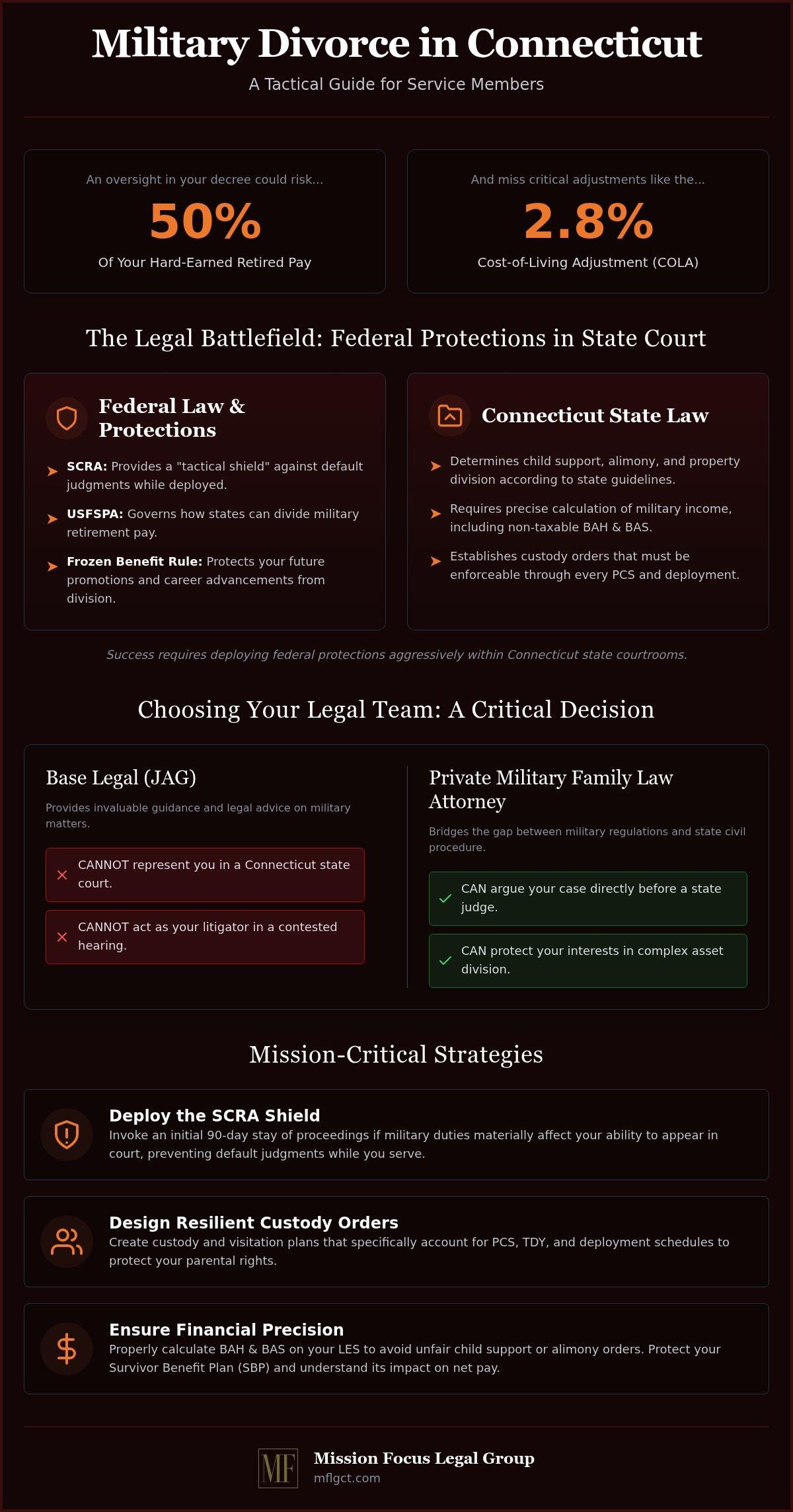
Your military pension is the crown jewel of your service benefits. It represents decades of sacrifice, missed holidays, and physical toll. In a Connecticut divorce, this asset is often the most contested piece of the puzzle. Protecting it requires more than just a general understanding of property division; it requires a strategic defense against over-calculation. We focus on “Disposable Retired Pay,” which is the amount left after accounting for taxes and disability offsets. Failing to distinguish between gross and disposable pay can result in a court order that drains your bank account far beyond what the law requires.
Current economic shifts make this precision even more critical. For example, current military retirees are seeing a 2.8% cost-of-living adjustment (COLA) in 2026, while those retiring this year benefit from a 3.8% increase due to basic pay raises. These adjustments impact your long-term financial planning and how your retirement is valued in a settlement. If you are concerned about how your 20-year mission will be divided, contact a military family law attorney who understands the tactical importance of pension defense.
NDAA 2017 and the “Frozen Benefit” Calculation
One of the most significant protections for service members is the “Frozen Benefit Rule” established by the National Defense Authorization Act of 2017. Before this change, a former spouse could benefit from promotions and pay raises you earned years after the divorce was finalized. Now, federal law mandates that your pension must be valued based on your rank and years of service at the time of the divorce decree. This means your hard work as you climb from E-7 to E-9 or O-4 to O-6 after the split belongs solely to you. We ensure your Court Order Acceptable for Processing (COAP) includes the exact language required by DFAS to enforce this freeze.
Tricare and Healthcare Post-Divorce
Healthcare continuity is a major concern for military families. Eligibility for post-divorce Tricare benefits is governed by the 20/20/20 rule. To qualify, you must have been married for at least 20 years, have at least 20 years of creditable service, and have a 20-year overlap between the marriage and the service. If the overlap is only 15 years, the spouse may qualify for one year of transitional coverage under the 20/20/15 rule. We also help families negotiate for the Continued Health Care Benefit Program (CHCBP), which acts as a bridge for those who don’t meet the strict 20-year requirements. Protecting your health and your spouse’s access to care requires clear, enforceable language in your final agreement.
Securing Your Future: Why a Veteran-Led Firm is Your Best Asset
The complexities of the SCRA, USFSPA, and Connecticut’s domestic statutes require more than just a legal degree. They require a specific type of discipline. When your career and your family’s financial stability are on the line, you don’t need a passive observer. You need a military family law attorney who understands the weight of your service and the tactical requirements of your case. We approach every file with the same level of preparation and persistence that you bring to your own mission.
Attorney Keith Anthony leads Mission Focus Legal Group with a unique perspective forged as a U.S. Marine Corps Reserve Major and former Judge Advocate (JAG). This isn’t just about knowing the law; it’s about speaking the language. We understand the high-stakes nature of military life in Groton, New Haven, and throughout the state. Our representation is mission-oriented, focusing on your specific objectives while providing the steady, calming presence you need during a high-stress legal battle.
The Advantage of a Former JAG
A former JAG brings a “command” perspective to domestic issues that civilian lawyers simply don’t possess. We don’t struggle to read an LES or decipher the nuances of an ORB/ERB or retirement point sheet. We’ve stood in your boots and understood the pressure of maintaining a security clearance while navigating a divorce. This background allows us to anticipate how a command might react to certain legal maneuvers and how to protect your military standing. We use this expertise to ensure every detail of your service record is accurately represented in court, preventing the common oversights that often haunt service members for years after their case is closed.
Take the First Step: Your Initial Consultation
Preparation is the foundation of any successful operation. During your initial consultation, we begin building your “Legal Operations Plan” by identifying your primary goals and the potential obstacles in your path. To make the most of this strategy session, you should bring your recent LES, any existing court orders, and your most recent evaluation reports if career protection is a concern. We’ll strip away the legalese and provide you with a direct, strategic assessment of your situation.
You’ve spent your career protecting others; now it’s time to protect yourself. Whether you’re stationed at the Naval Submarine Base New London or transitioning to civilian life in Connecticut, we’re ready to serve as your battle-tested ally. Contact Mission Focus Legal Group today to protect your military career and family future with a firm that understands the cost of your service.
Mission Success Starts with Strategic Legal Planning
Navigating a divorce while serving shouldn’t feel like a solo mission. You’ve seen how federal shields like the SCRA protect you from default judgments and why the “Frozen Benefit Rule” is essential for keeping your future promotions out of a settlement. From calculating BAH correctly to ensuring your custody orders account for a sudden PCS, the details of your service record are your most important assets. These aren’t just administrative hurdles; they’re the foundation of your future stability.
Working with a veteran-led military family law attorney ensures these details are leveraged to your advantage rather than overlooked by a civilian court. Mission Focus Legal Group is led by USMCR Major Keith Anthony, a former JAG officer who has spent over 10 years serving Connecticut military families. We speak your language and understand the unique pressures of the Groton Sub Base community. You’ve dedicated your life to the mission; let’s handle the tactical defense of your home front.
Schedule Your Strategic Military Family Law Consultation today to build your legal operations plan and secure what you’ve earned.
Frequently Asked Questions
Can my ex-spouse get half of my military retirement in a Connecticut divorce?
Yes, a Connecticut court has the authority to divide military retired pay as marital property, but it is not a federal requirement or an automatic entitlement. The specific amount depends on the length of the marriage and years of service. Under the 2017 Frozen Benefit Rule, the court must value the pension based on your rank and pay grade at the time of the divorce decree, protecting any future promotions you earn.
How does a deployment affect my child custody rights in CT?
Deployment cannot be the sole basis for a permanent change in custody under Connecticut law. Instead, the court can issue temporary orders to accommodate your absence while ensuring your parental rights “snap back” to the original status once you return. It’s critical to have a military family law attorney draft these orders to include specific language regarding rights of first refusal for your extended family members to provide care.
Is my BAH and BAS included when calculating child support in Connecticut?
Yes, Connecticut courts generally include Basic Allowance for Housing (BAH) and Basic Allowance for Subsistence (BAS) as gross income when calculating child support. Because these are non-taxable allowances, they can significantly increase your “income” in the eyes of the court compared to a civilian with the same base salary. Accurate calculation is vital to ensure the support order is fair and sustainable based on your actual Leave and Earnings Statement.
What is the “10/10 Rule” in military divorce and does it apply to me?
The 10/10 Rule determines how your former spouse receives their portion of your retirement pay, not whether they are entitled to it. If you were married for at least ten years overlapping with ten years of service, DFAS pays the spouse directly. If your marriage was shorter, the court can still award a portion of the pension, but you will be responsible for making those payments to your ex-spouse yourself.
Can a Connecticut court order me to pay for my ex-spouses Survivor Benefit Plan (SBP)?
Yes, a Connecticut judge can order you to maintain a Survivor Benefit Plan (SBP) for a former spouse as part of a divorce settlement. The court also has the discretion to decide who pays the premiums, which are typically deducted from your gross retired pay. This is a significant financial obligation that should be negotiated carefully to ensure it doesn’t disproportionately impact your net monthly income after retirement.
What happens if I am served with divorce papers while I am deployed OCONUS?
If you are served while OCONUS, you should immediately invoke your rights under the Servicemembers Civil Relief Act (SCRA). You are entitled to an initial 90-day stay of proceedings if your military duties prevent you from appearing in court. This protection prevents a default judgment from being entered against you while you are at sea or in a remote location, giving you time to secure a military family law attorney.
Does the Navy or Marine Corps have a regulation for child support before a court order?
Yes, both the Navy and Marine Corps have specific regulations requiring service members to provide adequate financial support to their dependents even without a court order. For example, the Navy uses MILPERSMAN 1754-030 and the Marine Corps follows MCO 5800.16 to set interim support standards. These internal military guidelines remain in effect until a Connecticut court issues a formal child support or alimony order that supersedes them.
How do I protect my security clearance during a contentious military divorce?
Protecting your security clearance requires proactive transparency with your Facility Security Officer (FSO) and meticulous financial management. Contentious divorces often involve allegations that could trigger a review, so it is essential to avoid debt delinquency or behavior that suggests poor judgment. We help you navigate the litigation while ensuring your conduct remains beyond reproach, minimizing the risk to your professional standing and mission readiness.
Call For A Consultation
(860) 333-6455