
Is a single night of poor judgment enough to dismantle a decade of professional excellence? For many Connecticut professionals, the primary concern after an arrest isn’t just the courtroom; it’s the boardroom. You are likely wondering, will a misdemeanor dui affect employment and jeopardize the security you’ve built for your family? The fear of immediate termination or the revocation of a professional license is a heavy burden to carry alone. We understand that you feel exposed, but a strategic defense can turn a potential career derailment into a mission for preservation.
In this guide, we provide you with a tactical roadmap to protect your professional future in 2026. You’ll discover exactly how Connecticut’s labor laws and the updated Clean Slate Law impact your disclosure requirements. We examine which industries are most sensitive to these charges and outline a disciplined plan for career preservation. From understanding the nuances of nursing license self-reporting to the realities of security clearances, you will gain the clarity needed to move from a state of vulnerability to a position of informed strength.
Key Takeaways
- Understand how Connecticut’s at-will employment laws impact your job security and the critical legal distinctions between a pending arrest and a final conviction.
- Identify the specific risks for safety-sensitive roles, including how a misdemeanor DUI will affect employment for CDL holders, healthcare providers, and those requiring security clearances.
- Navigate the complexities of the Connecticut Clean Slate Law to determine if your record qualifies for automatic erasure and what limitations remain in 2026.
- Master a tactical disclosure framework to handle employer inquiries with accountability while protecting your professional reputation from unnecessary damage.
- Learn how a disciplined, mission-oriented legal defense can mitigate long-term career consequences and keep your professional trajectory on track.

Call For A Consultation
(860) 333-6455Table of Contents
- The Immediate Impact: Can You Be Fired for a Misdemeanor DUI in Connecticut?
- High-Stakes Careers: Professional Licenses and Security Clearances
- Connecticut Specifics: Background Checks and the Clean Slate Law
- Strategic Mitigation: How to Handle Employer Disclosure
- Disciplined Defense: How Mission Focus Legal Group Protects Your Livelihood
The Immediate Impact: Can You Be Fired for a Misdemeanor DUI in Connecticut?
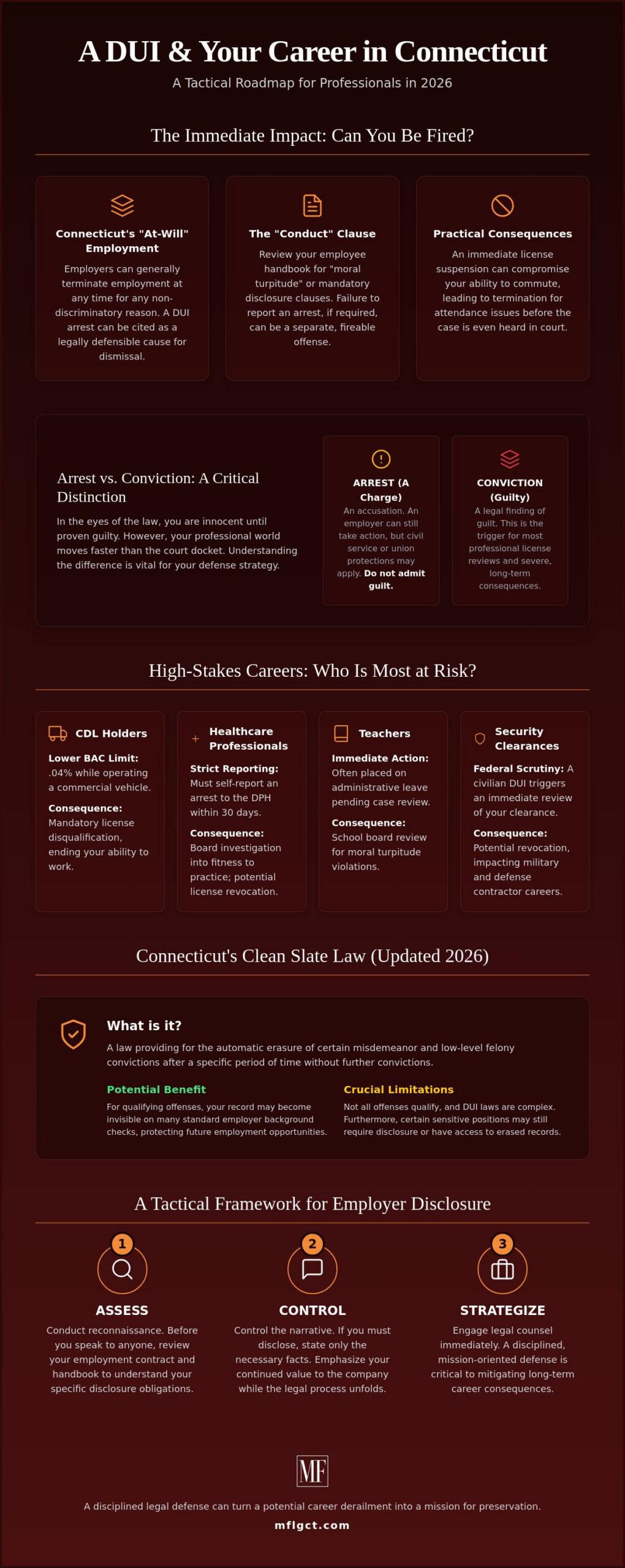
The threat to your livelihood begins the moment the handcuffs click shut. In Connecticut, the legal battle in the courtroom is only half the fight; the other half occurs within your company’s human resources department. Many professionals ask, will a misdemeanor dui affect employment in a way that leads to immediate termination? Because Connecticut is an at-will employment state, the reality is often sobering. Employers generally have the right to terminate an employee at any time, for any reason, or for no reason at all, provided the decision isn’t discriminatory. A DUI arrest provides a convenient, legally defensible reason for an employer to part ways with a staff member they deem a liability.
Beyond the legal right to fire, there are immediate logistical hurdles that can trigger a termination. If your license is suspended, your ability to commute to work is compromised. For many, a failure to show up for a shift is a more common cause for firing than the arrest itself. While DUI laws in the United States provide a framework for criminal penalties, the civil consequences often hit harder and faster than a judge’s sentence. You must act with military-grade precision to manage your employer’s perception and maintain your standing within the organization.
At-Will Employment and the “Conduct” Clause
Most professional contracts contain “conduct unbecoming” or “moral turpitude” clauses. These broad terms allow companies to fire employees for off-duty behavior that reflects poorly on the brand. You must review your employee handbook immediately to identify mandatory reporting requirements. Failing to disclose an arrest when your contract requires it is often viewed as a secondary, fireable offense. We approach these situations like a tactical reconnaissance mission: we identify the specific threats in your contract so we can build a defense that protects your reputation and your paycheck.
Arrest vs. Conviction: The Legal Threshold
There is a critical distinction between being charged and being found guilty. In the eyes of the law, you remain innocent until proven guilty, but the professional world moves faster than the court docket. However, for those in unionized positions or with specific civil service protections, an arrest alone might not be sufficient grounds for termination. It’s vital that you do not admit guilt to an employer prematurely. Any statement you make to a manager or HR representative can be used against you in court. Silence is your strongest asset until a strategic plan is in place. We advocate for a disciplined approach that emphasizes your continued value to the firm while the legal process unfolds.

Call For A Consultation
(860) 333-6455High-Stakes Careers: Professional Licenses and Security Clearances
For some, a DUI is a legal hurdle. For others, it’s a career-ending event. If you hold a specialized credential, the question of will a misdemeanor dui affect employment is answered by licensing boards and federal agencies rather than just a local manager. These bodies prioritize public safety and professional judgment above all else. A single conviction can trigger a cascade of disciplinary hearings, administrative fees, and the potential loss of your right to practice. You are no longer just defending your driving record; you are defending your professional identity.
Commercial Drivers and Healthcare Professionals
Commercial drivers (CDL) operate under the strictest standards in Connecticut. While the standard BAC limit is .08%, CDL holders face a lower threshold of .04% while operating a commercial vehicle. A first-offense conviction results in a mandatory disqualification period, effectively ending your ability to earn a living on the road. Healthcare professionals face similar scrutiny. Connecticut nurses must self-report any alcohol-related arrest to the Department of Public Health within 30 days. While a conviction doesn’t guarantee license revocation, the Board of Registered Nursing will investigate your ability to practice safely. Teachers in districts like New Haven or Groton often face immediate administrative leave while the school board reviews the case for moral turpitude violations.
Military Service and Security Clearances
For those in uniform or defense contracting, the stakes are uniquely high. A civilian DUI can trigger a Letter of Reprimand or administrative separation, even if the incident occurred off-base. Security clearances are not automatically revoked for a misdemeanor, but they are subject to Guideline G review regarding alcohol consumption. The Department of Defense looks for patterns of behavior rather than isolated lapses. Still, the concern remains: will a misdemeanor dui affect employment for those with Top Secret access? You must demonstrate proactive rehabilitation immediately. While Connecticut’s Clean Slate Law eventually offers automatic erasure after ten years, that timeline is often too late for an active-duty career or a clearance renewal. You need a defense that understands the nuances of both civilian and military law. If you are facing these high-stakes challenges, securing specialized criminal defense representation is the first step toward protecting your mission-critical credentials.

Call For A Consultation
(860) 333-6455Connecticut Specifics: Background Checks and the Clean Slate Law
Your criminal record is a digital footprint that doesn’t disappear just because you’ve served your time. In the hyper-connected job market of 2026, the question of will a misdemeanor dui affect employment often comes down to what a background check reveals to a prospective recruiter. Most Connecticut employers utilize third-party screening services that look back seven to ten years. While “Ban the Box” laws prevent employers from asking about criminal history on initial applications, they are legally permitted to run a check after a conditional offer is made. If a conviction appears, you must have a strategic narrative ready to deploy.
Connecticut has implemented specific protections to help individuals reclaim their professional standing, but these laws are complex and contain strict exceptions. Understanding the timeline of your record is the first step in a disciplined defense of your career. Relying on luck is not a strategy; you must understand the legal mechanisms that determine when and how your past becomes invisible to the public eye.
The CT Clean Slate Law in 2026
As of 2026, the Connecticut Clean Slate Law provides for the automatic erasure of many misdemeanor records. However, DUI convictions are handled with a higher level of scrutiny than standard offenses. While most misdemeanors are erased after a seven-year waiting period, a misdemeanor DUI requires a ten-year period of “clean” behavior following the conviction date. To qualify for this automatic erasure, you must have completed all aspects of your sentence, including probation and any court-ordered programs. If you are arrested for a subsequent DUI within that ten-year window, the clock resets, and the original conviction remains visible. Once a record is officially erased, Connecticut law allows you to state that the arrest or conviction never occurred during most job applications.
The Pardon Strategy for Professionals
Waiting a full decade for an automatic erasure is often unacceptable for high-achieving professionals. If you need to clear your record sooner to pursue a promotion or a new certification, an absolute pardon is your tactical objective. The Connecticut Board of Pardons and Paroles has the authority to grant a pardon that completely wipes the conviction from your history. Eligibility typically begins three years after a misdemeanor conviction. This process is rigorous and requires a thorough demonstration of rehabilitation, community involvement, and professional stability. We view the pardon application as a mission-critical operation. It requires meticulous documentation and a persuasive presentation of your character to convince the board that you are more than a single mistake. A successful pardon doesn’t just hide the record; it restores your legal standing as if the conviction never happened.
Strategic Mitigation: How to Handle Employer Disclosure
Disclosure is not a confession; it is a strategic maneuver. When you are grappling with the question of will a misdemeanor dui affect employment, the timing and method of your communication can be the difference between a supportive response and a pink slip. Silence might feel safe, but it often leaves you vulnerable to a surprise discovery during a routine background check or a local news sweep. Controlling the narrative requires a disciplined approach that prioritizes professional integrity while minimizing legal exposure. You must move with purpose to ensure your employer hears the facts from you first, framed within a context of accountability and corrective action.
We treat employer communication like a mission-critical briefing. It requires thorough reconnaissance of your company’s internal policies and a clear understanding of your legal obligations. By preparing a structured response, you demonstrate that you are a responsible professional who has already taken steps to mitigate future risks. This proactive stance often disarms HR departments that are otherwise trained to view any arrest as a red flag. We help you build a defense that doesn’t just happen in court but extends into your professional life.
The Disclosure Decision Matrix
Before you speak to a manager, you must evaluate your situation through a tactical lens. Your first objective is to review your employee handbook for mandatory reporting deadlines. Some Connecticut firms require notification within 24 to 48 hours of an arrest, and missing this window is often a fireable offense for “insubordination.” Next, assess if your role is safety-sensitive or requires a state-issued license, as these positions have higher disclosure thresholds. Finally, determine the likelihood of the arrest appearing in local Connecticut news or police blotters. If the information is destined to become public, you must be the one to break the news. This matrix ensures you aren’t disclosing unnecessarily while protecting you from the fallout of a hidden record.
Crafting the Professional Narrative
When the time comes to speak, your narrative must be anchored in extreme ownership. Avoid the “victim” mentality or blaming external circumstances; instead, present the incident as an isolated error in judgment that does not reflect your professional standard. Highlight the proactive steps you’ve already taken, such as enrolling in the Impaired Driving Intervention Program (IDIP) or seeking private counseling. We often provide our clients with “Letters of Explanation” drafted by legal counsel to present to HR. These documents use authoritative language to explain the legal status of the case while emphasizing your continued value to the organization. If you need a battle-tested ally to help you navigate these high-stakes conversations, securing tactical criminal defense representation is your best course of action. Documentation of your rehabilitation, including character references and program completion certificates, serves as your professional armor during these meetings.
Disciplined Defense: How Mission Focus Legal Group Protects Your Livelihood
The legal system is an adversarial landscape that requires a battle-tested strategy to navigate. At Mission Focus Legal Group, we don’t just provide representation; we provide a disciplined defense designed to protect your professional standing. Led by Attorney Keith Anthony, a USMC Reserve Major and former Judge Advocate (JAG), our firm applies military-grade precision to every case. We understand that for a professional, the central concern remains: will a misdemeanor dui affect employment and derail years of hard work? Our mission is to ensure that a single lapse in judgment does not become a permanent barrier to your success. We combine high-stakes authority with a deeply rooted commitment to our clients’ futures.
Immediate intervention is your best defense. The earlier we engage with your case, the more opportunities we have to influence the outcome before it reaches a courtroom or an HR desk. We operate at the intersection of criminal, military, and education law, providing a comprehensive shield for those with the most to lose. By treating your case as a mission-critical operation, we move with a sense of controlled momentum to secure the best possible results.
A Strategic Approach to DUI Defense
Our tactical approach begins with a relentless examination of the prosecution’s evidence. We scrutinize every detail of the police procedure, from the initial reason for the stop to the administration of roadside tests and breathalyzers. If an officer failed to follow strict Connecticut protocols, we move to suppress that evidence. Beyond the courtroom, we focus on securing entry into Pre-Trial Diversionary Programs, such as the Alcohol Education Program (AEP). Successful completion of these programs can lead to the total dismissal of charges, ensuring your record remains clean. We also provide direct advocacy during professional licensing board hearings and military administrative actions, ensuring your side of the story is told with authority and clarity.
Protecting Professionals in Groton, New Haven, and Beyond
With over 10 years of experience serving the Connecticut community, we have developed a deep familiarity with the local court systems from Norwich to Middletown. We understand the specific tendencies of local prosecutors and judges in Groton and New Haven, allowing us to tailor our strategy to the specific jurisdiction where your case is heard. Our communication is always transparent and methodical, moving you from a state of uncertainty to a position of informed strength. We believe that every professional deserves a fierce advocate who is also a steady partner in private consultation. Protect your career—schedule a consultation with Mission Focus Legal Group today.
Secure Your Professional Mission
A misdemeanor DUI doesn’t have to be the final chapter of your career. While the question of will a misdemeanor dui affect employment is complex, you now have the tactical framework to fight back. We’ve explored the nuances of Connecticut’s at-will employment, the critical importance of professional license protection, and the strategic advantages of the Clean Slate Law. Success in these high-stakes situations depends on proactive movement and a disciplined narrative. You don’t have to carry this burden alone.
Mission Focus Legal Group, led by Attorney Keith Anthony, a USMC Reserve Major and former JAG, brings military-grade precision to your defense. With over 10 years of experience and specialized expertise in military, criminal, and education law, we provide the strategic advocacy Connecticut professionals need to protect their livelihoods. Your future is worth defending. With the right ally, you can navigate this challenge and emerge with your reputation and career path intact.
Protect your future with a disciplined DUI defense—Contact us today.
Frequently Asked Questions
Will a DUI show up on a standard background check in Connecticut?
Yes, a misdemeanor DUI conviction is a matter of public record and will appear on standard background checks until it is officially erased. Most commercial screening services used by Connecticut employers look back seven to ten years. While the Clean Slate Law provides a path for automatic erasure, the conviction remains visible to recruiters during that waiting period. We recommend having a tactical disclosure plan ready if a background check is a condition of your employment offer.
Can I be fired for a DUI arrest before I am even convicted?
Connecticut is an at-will employment state, meaning an employer can legally terminate you for a DUI arrest even before a court reaches a final verdict. Many professional contracts include “conduct unbecoming” clauses that allow for dismissal based on off-duty behavior that reflects poorly on the organization. While you are innocent until proven guilty in a court of law, your job security often depends on the specific language in your employment agreement and your company’s internal policies.
Do I have to tell my boss about a misdemeanor DUI in CT?
Your duty to disclose depends entirely on your employment contract and the specific nature of your professional role. You should immediately review your employee handbook for mandatory reporting requirements, as some Connecticut firms require notification of any arrest within 48 hours. Failing to disclose when required is often a separate, fireable offense for insubordination. If you are unsure of your obligations, consulting with legal counsel can help you determine if a strategic disclosure is necessary to protect your standing.
How long does a misdemeanor DUI stay on my record in Connecticut?
A misdemeanor DUI conviction typically remains on your record for ten years before qualifying for automatic erasure under the Clean Slate Law. This is a longer duration than the seven-year period required for most other misdemeanors in the state. To ensure eligibility, you must complete all aspects of your sentence and remain free of any subsequent convictions during that decade. If you need to clear your record sooner, you may be eligible to petition for an absolute pardon after three years.
Will a DUI affect my military career or security clearance?
A civilian DUI triggers a mandatory review of your security clearance and can lead to administrative action under the UCMJ. While an isolated misdemeanor is not an automatic disqualification for a Secret or Top Secret clearance, it is reviewed under Guideline G regarding alcohol consumption. You are required to self-report the incident to your Security Manager immediately. We apply our JAG background to help service members navigate these reviews and demonstrate the proactive rehabilitation needed to save their careers.
What jobs are most likely to fire me for a misdemeanor DUI?
Safety-sensitive positions and roles requiring state-issued professional licenses face the highest risk of immediate termination. This includes CDL drivers, healthcare workers, educators, and defense contractors. Because these roles involve public safety or high-level trust, employers often view a DUI as a direct violation of professional standards. Understanding how a misdemeanor dui affect employment in these specific sectors is vital for building a defense that addresses both legal and professional consequences.
Can I get a DUI “expunged” or erased in Connecticut?
Yes, Connecticut provides two primary paths for record erasure: the Clean Slate Law and the absolute pardon process. The Clean Slate Law offers automatic erasure after a ten-year waiting period for eligible first-time offenders. Alternatively, you can apply for an absolute pardon, which is a petitioned request that can clear your record much faster if granted. Our firm specializes in preparing these petitions to help professionals restore their clean records and move forward without the weight of a past conviction.
What happens to my professional license (nursing, teaching) after a DUI?
A DUI arrest initiates an investigation by your respective licensing board, such as the Department of Public Health for nurses or the Department of Education for teachers. You are generally required to self-report the arrest within a specific timeframe, often 30 days for nursing professionals. While a single misdemeanor does not always result in license revocation, the board will evaluate your fitness to practice and may impose probationary terms. We provide aggressive representation during these administrative hearings to protect your right to work.
Call For A Consultation
(860) 333-6455