
Mistaking alimony for child support is a tactical error that can compromise your financial independence for years. Many people assume these payments are interchangeable, yet in Connecticut, they serve entirely different missions. Understanding the distinctions of alimony vs child support is the first step in defending your future and ensuring your family remains secure during a high stakes transition.
The fear of being taken advantage of in a courtroom is a heavy burden to carry. You want to ensure your children have every resource they need without sacrificing your own right to a stable life. It’s natural to feel overwhelmed by legal terminology, but you don’t have to face this alone. This guide provides the clarity you need to master Connecticut support laws so you can approach your case with the confidence of a well prepared advocate.
We’ll walk you through the 2026 child support reform, the specific factors that influence alimony awards, and the strategic shifts caused by recent tax law changes. This overview ensures you’re equipped with the facts to protect your rights and your children’s well being.
Key Takeaways
- Define the distinct legal missions of spousal maintenance and child support to ensure your financial strategy is built on a solid foundation.
- Contrast the rigid Income Shares formula used for children against the discretionary factors judges weigh when determining alimony vs child support amounts.
- Learn the specific timelines for payment termination, including how Connecticut law handles high school graduation and the duration of your marriage.
- Grasp the modern tax implications of support agreements to prevent unexpected liabilities under current federal and state regulations.
- Establish a strategic plan for financial stability by applying disciplined discovery methods to your divorce proceedings.

Call For A Consultation
(860) 333-6455Table of Contents
Defining the Mission: What Are Alimony and Child Support?
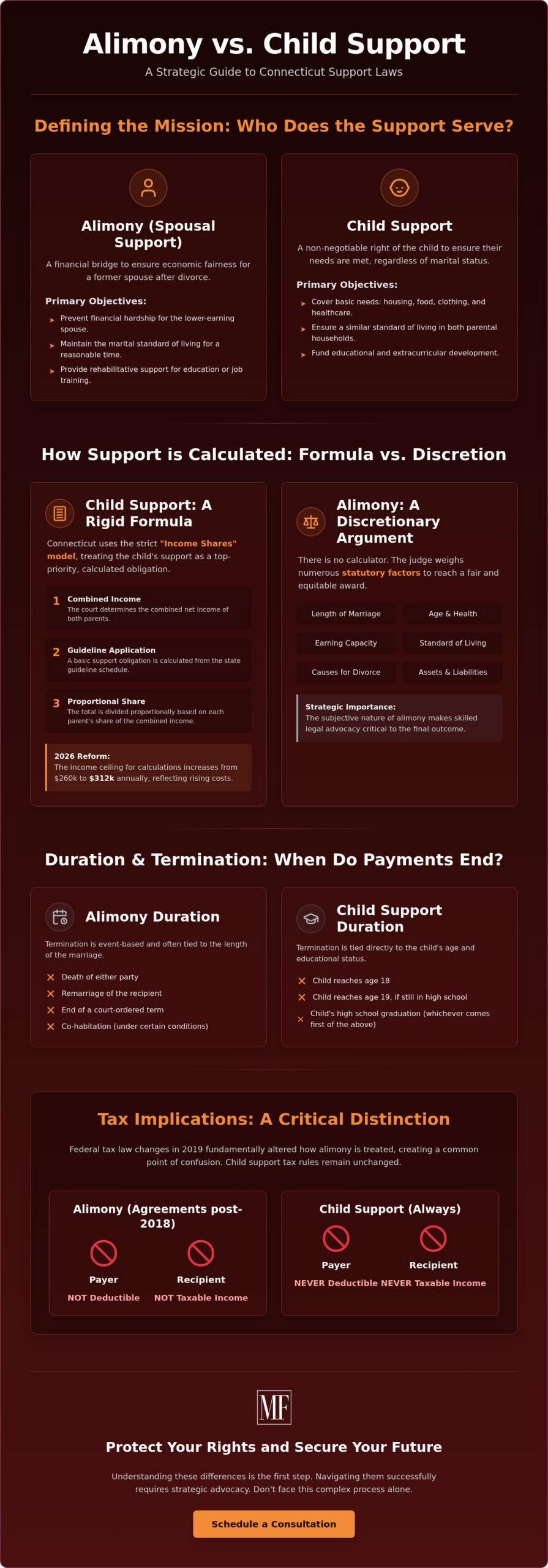
Clarity is your greatest asset during a divorce. To protect your interests, you must first understand the specific legal objectives behind every dollar exchanged. Connecticut law does not view financial support as a single, monolithic payment. Instead, it categorizes these obligations based on who they are intended to serve and why. When assessing the strategic impact of alimony vs child support, you must recognize that Connecticut courts treat these as distinct legal missions with zero overlap in their primary targets.
The debate of alimony vs child support often centers on the recipient, but the law focuses on the beneficiary. While a custodial parent might physically receive both payments, the legal target is different. Alimony serves the former partner; child support serves the child. These are separate obligations with distinct social purposes that the court will not allow you to conflate. Understanding this distinction prevents you from being blindsided during negotiations or court proceedings.
The Purpose of Spousal Maintenance
Spousal support, often called alimony, is a mechanism for economic fairness between two adults who were once a single financial unit. By Defining Alimony as a bridge, the court acknowledges that one spouse may have sacrificed earning potential or career growth for the benefit of the marriage. This is not a reward or a punishment; it is a strategic tool to stabilize the household of the lower earning spouse.
The mission here is three-fold. First, it prevents a lower earning spouse from becoming a ward of the state by ensuring they have the means to survive. Second, it aims to maintain the marital standard of living established during the union for a reasonable period. Finally, it often provides rehabilitative support. This allows a spouse the time and resources needed to acquire new job skills or educational credentials to become self sufficient in the modern economy.
The Purpose of Child Support
Child support operates under a different set of rules and higher stakes. In Connecticut, support is considered a non-negotiable right of the child, not a benefit for the parent. You cannot waive child support in a private agreement because the court acts as the ultimate protector of the child’s best interests. It is a mandatory contribution to the child’s future.
The primary objective is to cover the basic needs of the child, including safe housing, nutritious food, clothing, and comprehensive health insurance. Beyond survival, the law seeks to ensure that children enjoy a similar standard of living in both households. This prevents a jarring economic disparity when the child moves between parents. It also covers educational expenses and extracurricular requirements, ensuring the child’s development remains a priority regardless of the parents’ marital status.
Understanding these definitions is the only way to build a strategic plan for your financial stability. You aren’t just paying or receiving money; you are fulfilling a specific legal mandate designed to stabilize your family’s future. By recognizing these roles, you can better prepare for how the court will evaluate your specific situation.

Call For A Consultation
(860) 333-6455How Connecticut Calculates Support: Formula vs. Discretion
Precision is required when calculating financial obligations that will dictate your lifestyle for years to come. In the strategic landscape of alimony vs child support, the methods used to reach a final number are fundamentally different. Child support is governed by rigid mathematical guidelines, while alimony is determined through a complex evaluation of statutory factors. One is a calculation; the other is an argument.
The court approaches these two figures with different levels of flexibility. While child support follows a predictable path based on combined income, alimony remains highly subjective. This means your choice of legal advocate directly impacts the outcome of your spousal support award. Connecticut courts typically view the length of the marriage as a primary indicator of how long alimony payments should persist, but this is only one piece of a much larger puzzle.
The Connecticut Child Support Guidelines
Connecticut utilizes the “Income Shares” model to determine child support. This model assumes the child should receive the same proportion of parental income they would have received if the parents still lived together. Under the new guidelines effective August 1, 2026, the income schedule ceiling for these calculations increases from $260,000 to $312,000 annually. This shift reflects the rising costs of raising a child in the modern economy.
The court calculates a basic support obligation from the combined net weekly income of both parents. It then adjusts this figure for health insurance premiums and work-related daycare costs. While the formula is strict, a judge may deviate from it based on specific “deviation criteria.” These include the child’s extraordinary needs, the parent’s significant assets, or a coordinated family form where the child spends substantial time with both parents. Understanding these nuances is critical for accurate Family Law Representation that protects your rights.
The 12 Factors of Alimony in CT
Unlike the formulaic nature of child support, alimony has no fixed calculator. Instead, under C.G.S. § 46b-82, the court examines 12 distinct statutory factors to determine the amount and duration of spousal support. Judges evaluate the causes for the dissolution, the age, health, station, and occupation of each party. They also weigh the estate and needs of each person to reach an equitable decision.
Crucially, the court evaluates “earning capacity” rather than just actual current income. If a spouse is intentionally underemployed or hiding assets, the judge may impute income based on what they could be earning through reasonable effort. This is where thorough financial discovery, often involving experts like the International Investigative Group, becomes a tactical necessity.
For service members stationed in Groton, or military families throughout Connecticut, these calculations involve additional layers of complexity. Gross income for support purposes must account for non-taxable allowances like Basic Allowance for Housing (BAH) and Basic Allowance for Subsistence (BAS). Failing to include these can lead to inaccurate support orders that jeopardize your financial standing. Every line item of your Leave and Earnings Statement (LES) must be correctly interpreted to ensure a fair outcome.

Call For A Consultation
(860) 333-6455Duration and Termination: When Do Payments End?
Every financial mission needs a clear exit strategy. When you are planning for life after divorce, understanding the finish line for your obligations is just as critical as knowing the monthly amount. In the strategic landscape of alimony vs child support, the duration of payments is governed by two entirely different sets of rules. One is largely dictated by the age of your children, while the other is a variable timeline often tied to the history of your marriage.
Child support in Connecticut has a standard expiration date. Generally, these payments terminate when a child reaches the age of 18. If the child is still a full-time high school student and living with a parent, the obligation extends until they graduate or turn 19, whichever occurs first. Alimony, however, is far more subjective. While there is no hard formula, Connecticut judges often correlate the duration of spousal support with the length of the marriage. A twenty year union may result in a longer support term than a five year marriage, but this is always subject to the court’s discretion.
Both types of support are subject to modification if life takes an unexpected turn. To change an existing order, you must prove a “substantial change in circumstances.” Under Connecticut law, a 15% or greater change in income is typically considered sufficient grounds to request a modification. This ensures that the support remains fair as your financial reality evolves.
Ending Alimony: Remarriage and Cohabitation
Specific trigger events can end alimony early, even if the court order specified a longer term. In most Connecticut divorce decrees, remarriage by the recipient spouse automatically terminates the payer’s obligation. However, the “Cohabitation” rule is more complex. If the recipient is living with another person and that relationship results in a change in their financial needs, the court may choose to modify or terminate alimony. Proving cohabitation requires more than just showing a romantic partner stays over; you must demonstrate that the partner is providing financial support or that the recipient’s expenses have significantly decreased because of the arrangement.
Post-Secondary Education Support
Connecticut offers a unique protection for families that extends beyond standard child support. Under C.G.S. § 46b-56c, the court has the authority to enter an educational support order. This can require parents to contribute to college expenses, including tuition, room, board, and books, until the child reaches the age of 23. This is a distinct obligation from the child support that ends at 18 or 19. To remain eligible, the child must maintain good academic standing and provide transcripts to both parents. Strategic planning during the divorce process is essential to ensure these future educational needs are addressed without compromising your personal financial rights.
Tax Implications and Common Financial Misconceptions
Financial strategy is a game of net numbers. When you are negotiating alimony vs child support, the total amount on the page doesn’t tell the whole story. You must account for the silent partner in every divorce: the IRS. Failing to understand the tax treatment of these payments can result in a settlement that looks fair on paper but leaves you with a significant financial deficit in reality. Protective advocacy requires a deep dive into how the government views your support structure, and you may also want to explore Insurance Policy Placement Commissions to ensure your long-term protection and legacy planning are built on a transparent foundation.
Child support has always been tax neutral at the federal level. The payer uses after tax dollars to make the payment, and the recipient does not report the funds as taxable income. Alimony, however, underwent a seismic shift that redefined how settlements are built. Beyond taxes, many clients worry about “Double Dipping,” which is the legal concept of using the same asset to satisfy both a property division and an alimony award. Connecticut courts generally aim to prevent this, but the intersection of income and assets remains a complex tactical challenge.
Net income is the most contested figure in Connecticut support hearings. Because the Income Shares model relies on net weekly income, every deduction and tax credit is a potential point of conflict. If your “net” figure is calculated incorrectly, you could end up with an obligation that exceeds your actual ability to pay. Ensuring these numbers are accurate requires the precision of experienced Family Law Representation to verify every line item on a financial affidavit.
The 2019 Tax Shift: What You Need to Know
Since January 1, 2019, the Tax Cuts and Jobs Act has fundamentally altered the landscape of alimony vs child support. For any divorce finalized on or after that date, alimony is no longer tax deductible for the person paying it, and it is not considered taxable income for the person receiving it. This is a permanent change that makes alimony more expensive for the payer in “real” dollars. If you are referencing an older decree from 2018 or earlier, the old rules likely still apply, meaning the payer can still deduct those payments. This disparity makes it vital to know exactly which set of rules governs your specific timeline.
Misusing Support: Oversight and Enforcement
A common source of friction is the belief that the recipient must prove how they spend child support. In Connecticut, the answer is usually no. The law assumes the custodial parent is using the funds for the child’s benefit, and courts rarely require an itemized receipt of expenses. However, if payments stop, the State of Connecticut Support Enforcement Services (SES) has a powerful arsenal of tools to ensure compliance. Consequences for non-payment are severe and can include wage garnishment, the suspension of your driver’s or professional license, and even a finding of contempt that could lead to incarceration. Maintaining a disciplined record of payments is your best defense against these high stakes enforcement actions.
Strategic Advocacy: How Mission Focus Legal Group Protects Your Interests
Victory in the courtroom is rarely the result of chance. It is the product of meticulous preparation, disciplined execution, and a deep understanding of the legal terrain. When you are facing the complexities of alimony vs child support, you need more than just a representative. You need a battle tested ally who treats your financial stability as a critical mission. At Mission Focus Legal Group, we apply military grade discipline to the process of financial discovery, ensuring that no stone is left unturned and no asset is left hidden.
Keith Anthony brings a unique perspective to every case, drawing on extensive experience in both the Connecticut Superior Court and Military Tribunals. This dual background allows for a level of strategic depth that is uncommon in traditional family law practices. Whether you are navigating a high net worth civilian divorce or a complex military separation, our approach remains the same. We identify the objectives, assess the risks, and move forward with a persistence that ensures your rights are protected against any adversary.
Military Specific Support Challenges
Service members in Groton and New London face a unique set of obstacles that civilian attorneys often overlook. We specialize in navigating the Uniformed Services Former Spouses’ Protection Act (USFSPA), which governs how military retirement pay is handled in divorce. Our firm provides a strategic defense for JAG related family law matters, ensuring that your service record and your financial future are both respected by the court.
Calculations for alimony vs child support become significantly more complex when deployments or Permanent Change of Station (PCS) moves occur. These events can shift income status overnight, leading to unfair support obligations if not handled correctly. We proactively protect our clients from the improper inclusion of non taxable allowances like BAH and BAS when those figures would lead to an inequitable result. Our mission is to ensure that your commitment to our country does not become a liability in your personal life.
Your Next Steps in Connecticut
The path to stability begins with a clear roadmap. In Connecticut, the Case Management Agreement is the foundational document that sets the timeline for your entire case. We prioritize this stage to ensure that your goals are clearly defined from day one. This preparation is especially vital when heading into “Pendente Lite” hearings, which establish temporary support orders that can last for months or even years while the divorce is pending. Getting these early orders right is essential for your long term financial health.
You do not have to carry the weight of legal uncertainty on your own. Our mission oriented approach is designed to lead you from a state of vulnerability to a position of informed strength. If you are ready to secure your future and protect your family with the help of a disciplined advocate, Schedule a strategic consultation with Mission Focus Legal Group today. We are ready to stand by your side and lead the way toward your new beginning.
Take Command of Your Financial Future
Securing your post-divorce life requires a disciplined understanding of the differences between alimony vs child support. You’ve learned that while child support follows a rigid formula to protect your children, alimony is a discretionary tool used to stabilize your own financial standing. Navigating these paths successfully demands precision; especially when dealing with modern tax implications and the specific challenges faced by military families in Groton and New London.
Attorney Keith Anthony, a U.S. Marine Corps Reserve Major with over 10 years of service in Connecticut, applies tactical expertise to every case. He specializes in both Military and Family Law, bridging the gap between complex legal statutes and the human need for security. He understands that your legal matter isn’t just about paperwork; it’s about protecting the mission of your family’s stability.
Don’t leave your future to chance in a courtroom. Secure your financial future; contact Mission Focus Legal Group today. You have the strength to move forward, and we have the strategy to lead the way.
Frequently Asked Questions
Can I receive both alimony and child support in Connecticut?
Yes, it’s common to receive both because they serve two distinct legal purposes. While child support is a non-negotiable right of the child, alimony is intended to bridge the economic gap between former spouses. The court calculates these separately, ensuring that the children are provided for while also addressing the financial disparity between the adults after the marriage ends.
How is alimony calculated if my spouse is in the military?
Alimony for military spouses is calculated by evaluating the same 12 statutory factors as civilian cases, but with a critical focus on non-taxable allowances. In Connecticut, judges must account for Basic Allowance for Housing (BAH) and Basic Allowance for Subsistence (BAS) when determining a service member’s gross income. This ensures the support award reflects the true income available to the household rather than just base pay.
What happens to child support if I lose my job in New Haven?
You must file a motion for modification immediately if you lose your job to prevent the accumulation of debt you can’t pay. Connecticut law doesn’t automatically adjust support orders when your income drops. Until a judge signs a new order, you remain legally responsible for the original amount. Proving a substantial change in circumstances is the only tactical way to align your payments with your new financial reality.
Does adultery affect alimony awards in Connecticut courts?
Adultery can influence alimony awards in Connecticut because the causes for the dissolution of the marriage is one of the 12 statutory factors judges must consider. While Connecticut is a no-fault divorce state, the court has the discretion to award more or less alimony based on marital misconduct. If adultery led directly to the breakdown of the union, it may impact the final financial mission.
Can child support be extended if my child has a disability?
Yes, child support can be extended until age 21 if a child has a physical or mental disability and lives with a parent. This extension recognizes that some children require ongoing financial protection beyond the standard age of majority. You must provide specific documentation of the disability to the court to ensure the support mission continues for as long as the child remains dependent and resides at home.
Is alimony permanent in Connecticut?
Permanent alimony is rare in modern Connecticut law and is typically reserved for very long marriages where one spouse can’t reasonably become self-sufficient. Most awards are time-limited alimony, which ends on a specific date or upon a trigger event like remarriage. The goal is often rehabilitative, providing the recipient with a bridge of support while they re-enter the workforce or obtain necessary job training.
What is the “Income Shares” model for child support?
The Income Shares model is a calculation method that combines the net weekly incomes of both parents to determine a basic support obligation. This model assumes that a child should receive the same proportion of parental income they would’ve enjoyed if the family remained intact. It creates a predictable, formulaic approach to alimony vs child support distinctions by focusing strictly on mathematical guidelines rather than judicial discretion.
How do I modify a support order in Groton or Mystic?
To modify a support order, you must file a formal motion for modification in the superior court where your original decree was issued. You are generally required to show a substantial change in circumstances, such as a 15% or greater shift in income. Whether you are dealing with alimony vs child support adjustments, acting quickly is essential to protect your rights and maintain your long-term financial stability.

Call For A Consultation
(860) 333-6455