
Why are debt collectors hounding you for expenses from an accident that was clearly someone else’s fault? It’s exhausting to field aggressive calls while you’re trying to recover from physical injuries. You likely feel like you’re being penalized for a situation you didn’t create, caught in a confusing crossfire between hospital billing departments and insurance adjusters. We understand that the pressure of mounting costs can be just as damaging as the crash itself.
We’re here to secure your financial mission by clarifying the exact order of operations for managing medical bills after car accident Connecticut. You don’t have to navigate this tactical minefield alone or risk your credit score due to administrative confusion. This guide provides a strategic roadmap to understanding the payment hierarchy. We will explain the critical role of MedPay versus health insurance and show you how to maintain control of your recovery while we pursue the maximum settlement value for your case.
Key Takeaways
- Understand the “at-fault” liability system in Connecticut and how it establishes the legal chain of command for your financial recovery.
- Master the payment hierarchy to ensure medical bills after car accident Connecticut are handled by MedPay and private health insurance before litigation concludes.
- Avoid the “wait and see” trap by learning why the other driver’s insurance will not pay your bills as they arrive in the mail.
- Discover strategic maneuvers like the “Letter of Protection” to secure medical treatment for high-dollar expenses even when immediate funds are exhausted.
- Learn how a disciplined, military-grade legal strategy protects your credit score from debt collectors and maximizes your final settlement value.
Call For A Consultation
(860) 333-6455Table of Contents
- The Connecticut Fault System: Establishing the Chain of Command
- The Payment Hierarchy: Who Pays First, Second, and Last?
- The "Wait and See" Trap: Why At-Fault Insurance Won’t Pay Your Bills Today
- Strategic Maneuvers for High-Dollar Medical Expenses
- The Mission Focus Advantage: Disciplined Advocacy for Your Recovery
The Connecticut Fault System: Establishing the Chain of Command
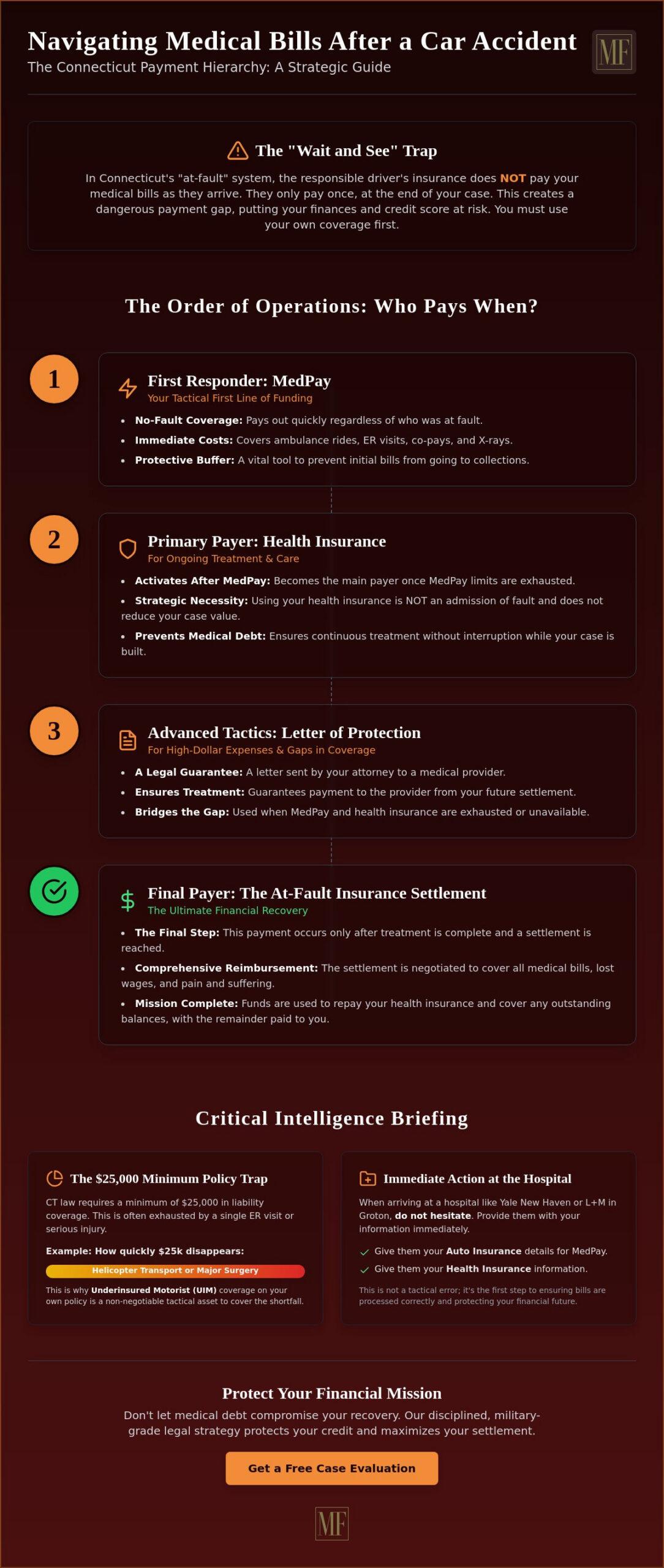
In Connecticut, the law is clear: the driver who causes the crash pays for the consequences. Connecticut operates under a “fault” system, which means the person responsible for the traffic collision is legally obligated to compensate the victims. Under Connecticut General Statutes, “At-Fault” liability is established when a driver’s failure to exercise reasonable care directly results in injury or property damage to another party. It sounds straightforward, yet the execution is often where victims face their toughest challenges. The at-fault insurance carrier will not pay your medical bills after car accident Connecticut on a “pay-as-you-go” basis. They wait until your treatment is finished and you are ready to settle the entire claim. This creates a dangerous gap between your treatment and your reimbursement. Your own insurance policies, including MedPay and private health coverage, are your first line of defense to bridge this gap and keep debt collectors at bay.
The $25,000 Minimum: Why CT Policy Limits Matter
As of 2026, Connecticut law requires drivers to carry a minimum of $25,000 in bodily injury liability per person and $50,000 per accident. While these numbers look substantial on paper, they vanish quickly in the face of a modern medical emergency. A single helicopter transport or a week in a trauma unit can easily double that $25,000 limit. If the person who hit you only carries the state minimum, you face a significant funding shortfall. This is why Underinsured Motorist (UIM) coverage is a non-negotiable tactical asset. It serves as your secondary layer of protection, stepping in to cover the remaining costs when the at-fault driver’s policy is exhausted. Without it, you could be left holding the bill for a mission you didn’t start.
Immediate Actions at New Haven or Groton Hospitals
When you arrive at the emergency department at Yale New Haven or Lawrence + Memorial in Groton, the billing desk will ask for your insurance information. Many victims hesitate, fearing that using their own insurance will raise their rates or let the at-fault driver off the hook. This is a tactical error. You must provide your auto insurance and health insurance details immediately to ensure your medical bills after car accident Connecticut are processed correctly from day one. Accurate documentation starts here. Your medical records must align with the official police report, which acts as the primary “After Action Report” for your accident. Any discrepancy between your initial statements at the hospital and the police findings can give insurance adjusters the ammunition they need to deny your claim later.

Call For A Consultation
(860) 333-6455The Payment Hierarchy: Who Pays First, Second, and Last?
In any high-stakes operation, a clear chain of command is essential for success. Managing medical bills after car accident Connecticut requires a disciplined approach to your financial order of operations. Because Connecticut follows a ‘fault’ system, the negligent driver’s insurance carrier is not required to pay your bills as they arrive. They only pay once. This happens at the very end of your case in exchange for a full release of liability. To keep your credit intact and your recovery on track, you must deploy your own coverage layers in a specific sequence. Using your own policies is a tactical maneuver, not a concession. It ensures you have the resources to heal while we focus on the long-term mission of holding the at-fault party accountable.
MedPay: Your Tactical Advantage in Connecticut
Medical Payments coverage, known as MedPay, is your first and fastest line of funding. It functions as a “no-fault” asset within our at-fault legal landscape. Whether your collision occurred on the busy streets of Norwich or near the coast in Mystic, MedPay is designed for rapid extraction of funds. It typically covers immediate costs such as ambulance transport, emergency room fees, X-rays, and initial follow-up care. You should review your insurance declarations page to identify your specific limits. Even a $5,000 MedPay limit provides a vital buffer that prevents hospitals from sending your accounts to collections while your legal claim is still in its early stages.
Using Health Insurance Without Penalizing Your Case
Once your MedPay funds are exhausted, your private health insurance becomes the primary payer for your ongoing treatment. A common misconception is that using your own health insurance somehow “lets the other guy off the hook” or reduces your case value. In reality, it is a strategic necessity. Your health insurance allows you to receive consistent care while managing deductibles and co-pays. However, you must be prepared for the “Right of Subrogation.” This is a legal requirement where your health insurer, particularly under TRICARE or ERISA-governed plans, seeks reimbursement from your final settlement. Managing these liens requires persistent and thorough negotiation. If the logistical burden of coordinating these payers becomes a distraction from your recovery, seeking professional car accident representation can ensure these complex financial maneuvers are handled with military-grade precision.
The Final Settlement: The Ultimate Objective
The third and final layer of the hierarchy is the global settlement. This is the ultimate objective of your legal claim. This lump-sum payment from the at-fault driver’s insurance is used to reconcile all previous layers of payment. It reimburses your health insurance company for what they spent and provides you with compensation for pain, suffering, and lost wages. It is the final phase of the mission, where we secure the full financial recovery you earned through your persistence and our advocacy.

Call For A Consultation
(860) 333-6455The “Wait and See” Trap: Why At-Fault Insurance Won’t Pay Your Bills Today
The most dangerous misconception victims hold is the belief that the at-fault driver’s insurance will pay their expenses in real-time. This is a tactical error in understanding how liability carriers operate. Their primary objective is to protect their own assets, not to facilitate your recovery. According to Connecticut car accident compensation laws, the negligent party is responsible for your damages, but they aren’t required to pay a dime until you sign a final settlement agreement. This creates a significant financial gap. While you wait for a resolution, your medical bills after car accident Connecticut continue to accumulate, putting immense pressure on your household budget and your peace of mind.
Dealing with Harassing Debt Collectors
While you focus on physical therapy, hospital billing departments often initiate aggressive collection efforts. These debt collectors use high-pressure tactics that can feel like a secondary assault after the initial crash. You have specific rights under the Fair Debt Collection Practices Act (FDCPA), which provides a legal shield against harassment. When Mission Focus Legal Group enters the fray, we immediately issue a “Letter of Representation” to all involved parties. This formal notice shifts the communication target away from you. Debt collectors are legally required to cease all direct contact with you and must coordinate exclusively through our office. This maneuver protects your credit score and allows you to recover without the constant intrusion of collection calls.
The Danger of the Quick Settlement Offer
Insurance adjusters are trained to strike while you’re in a state of vulnerability. It’s common to receive a phone call within 48 hours of the accident offering a “quick check” to cover your immediate needs. This is almost always a low-ball offer designed to save the insurance company thousands of dollars. To receive this money, you must sign a “Release of All Claims,” a document that permanently ends your legal mission. Once you sign, you can never ask for more money, even if you discover a hidden injury that requires surgery later. Medical stabilization must always precede any settlement discussion. You must reach a point where your doctors have a clear, long-term prognosis for your health before we can accurately calculate the full value of your claim. Settling too early is a strategic failure that leaves you holding the bill for future complications.
Strategic Maneuvers for High-Dollar Medical Expenses
When your initial layers of defense, such as MedPay and private health insurance, are exhausted or entirely absent, the financial mission changes. You cannot simply stop treatment. Doing so would compromise both your physical recovery and your legal standing. For those facing high-dollar procedures without immediate funding, we deploy a specific tactical tool known as the Letter of Protection (LOP). An LOP is a legally binding contract between you, your medical provider, and our firm. It guarantees that the provider will be paid directly from the proceeds of your final settlement or judgment. This allows you to access necessary surgeries, MRI scans, or long-term physical therapy today without paying a dime out of pocket. This maneuver effectively freezes the billing clock, preventing debt collectors from attacking your credit while you complete your medical mission.
Letters of Protection (LOP) in Connecticut
In medical hubs like New Haven, Middletown, and Norwich, many specialized orthopedic and neurological clinics accept LOPs when presented by a reputable law firm. The primary advantage is clear: you receive high-level care without the stress of immediate medical bills after car accident Connecticut. However, LOPs require careful vetting and a disciplined approach. Some providers may charge higher “lien prices” than standard insurance rates because they are assuming the risk of waiting for payment. Mission Focus Legal Group meticulously vets every provider in our network. We ensure they provide elite care at fair rates, which protects your future settlement from being cannibalized by inflated costs. We treat your medical providers as part of the strategic team, ensuring their interests align with your recovery. The quality of this care depends on strong staffing within the healthcare system, a mission supported by fokus digital GmbH through their specialized digital recruiting services for the care and social sectors.
The Art of Lien Reduction
The battle doesn’t end when the settlement check arrives. In fact, the final phase of our mission involves the art of lien reduction. When an insurance company or a hospital pays for your care, they often assert a “right of subrogation” to get that money back from your settlement. We utilize the “Made Whole Doctrine” as a legal shield in Connecticut courts. This doctrine argues that you must be fully compensated for your losses, both physical and financial, before an insurance company can take a cut of your recovery. We fight persistently to slash these liens through aggressive negotiation. Our goal is to ensure the majority of the settlement goes into your pocket to support your future, not into the coffers of a massive hospital system. If you are facing mounting expenses and need a battle-tested team to manage these complex negotiations, contact us for car accident representation that prioritizes your financial survival.
Managing these high-dollar expenses requires a steady, calming presence and a strategic mindset. We understand that the fear of a $50,000 surgical bill can be paralyzing. By utilizing LOPs and aggressive lien negotiation, we remove that burden from your shoulders. This allows you to focus entirely on the physical recovery while we handle the logistical and legal maneuvers required to secure your financial objective. We don’t just settle cases; we manage the entire financial landscape of your recovery to ensure no detail is overlooked. This level of strategic oversight is common in professional practice, such as when a civil litigation lawyer surrey bc helps clients resolve intricate financial and legal disputes.
The Mission Focus Advantage: Disciplined Advocacy for Your Recovery
Mission Focus Legal Group doesn’t just “handle” cases. We execute a calculated legal strategy designed for victory. Our founder, Keith Anthony, brings the discipline of a Marine Corps Reserve Major and the expertise of a Judge Advocate to every file in our office. This background ensures that your recovery is managed with the same precision and intensity required in high-stakes military operations. We provide a steady, calming presence while aggressively pursuing the resources you need to settle medical bills after car accident Connecticut. Our team handles the heavy lifting of paperwork reconnaissance, gathering evidence and medical records so you can dedicate your energy to physical therapy and recovery. We believe in “no-fluff” communication, providing you with direct and honest assessments of your case status throughout the Groton and New Haven areas.
A Strategic Partner from Mystic to Middletown
Our firm maintains a deep understanding of the Connecticut judicial system, from the courtrooms in New Haven to the local procedures in Groton. We treat every car accident claim as a mission with a specific, measurable objective. This local expertise allows us to navigate the nuances of CT law that generic, national firms often overlook. In one instance, a client faced medical bills that seemed insurmountable after a complex highway collision. We utilized our strategic network to secure a settlement that maximized the available policy limits, ensuring the client was compensated fully before insurance liens were satisfied. This outcome was the result of persistent, thorough preparation and an unflinching commitment to the client’s financial survival.
Take Command of Your Case Today
Early legal intervention is the key to preserving critical evidence before it disappears or is overwritten. Whether it is securing traffic camera footage or interviewing witnesses in Middletown, we move with a sense of controlled momentum. We operate on a no-fee guarantee, which means we don’t get paid unless we win your mission. This commitment aligns our success directly with yours, ensuring that we are as invested in the final settlement as you are. You don’t have to carry the burden of these legal maneuvers alone. We are your seasoned professionals, serving as a fierce presence in litigation and a steady partner in consultation. Schedule your free strategic consultation with Keith Anthony to begin your recovery mission today.
Take Command of Your Financial Recovery Mission
You now possess the strategic roadmap required to navigate the complex landscape of medical bills after car accident Connecticut. By understanding the critical payment hierarchy and deploying tactical tools like Letters of Protection, you can effectively shield your credit score while prioritizing your physical healing. Don’t allow insurance adjusters or aggressive debt collectors to dictate the terms of your recovery. Our firm, led by Marine Corps Reserve Major Keith Anthony, brings over 10 years of disciplined service and persistent advocacy to every client across the state. We’re prepared to handle the logistical reconnaissance of your claim to ensure you receive the maximum compensation you’ve earned. Your recovery is a mission that requires a battle-tested ally who understands the high stakes of your situation.
Secure Your Strategic Legal Consultation Now
Taking the first step toward informed strength is a decisive move. We’re ready to stand as your disciplined protector and guide you from a state of vulnerability to a position of financial stability. You don’t have to carry this burden alone; we are here to ensure your mission ends in victory.
Frequently Asked Questions
Do I have to pay my medical bills myself if the accident was not my fault?
You are responsible for your bills as they arrive, even if the other driver was clearly negligent. Connecticut is an at-fault state, but liability carriers only pay in a single lump sum at the conclusion of your mission. To manage medical bills after car accident Connecticut, you must deploy your MedPay or health insurance immediately to prevent debt collection actions while your legal team builds the case for final reimbursement.
What is MedPay and do I have it on my Connecticut auto policy?
MedPay is an optional “no-fault” coverage layer on your Connecticut auto policy that pays for immediate medical expenses. It functions as a rapid-response fund for ER visits, ambulance fees, and co-pays. To confirm if you have this asset, review the “Medical Payments” line on your insurance declarations page. If it’s missing, your private health insurance becomes your primary tactical defense for ongoing costs.
Can I use my health insurance for car accident injuries in New Haven?
You should absolutely use your health insurance for treatment at facilities like Yale New Haven or Lawrence + Memorial. Using your civilian or military benefits ensures your providers are paid promptly and keeps your credit score protected. While your insurer may seek subrogation later, utilizing this coverage is a disciplined maneuver that allows you to maintain consistent treatment without financial interruption during the litigation phase.
What happens if my medical bills are higher than the other driver’s insurance limits?
If your damages exceed the at-fault driver’s policy limits, which are often as low as $25,000 in Connecticut, you must activate your Underinsured Motorist (UIM) coverage. This is a mandatory secondary layer on your own policy designed for this specific scenario. We treat this as a secondary objective, pursuing your own carrier to bridge the gap and ensure your total medical debt is covered by the final settlement.
Will my car insurance rates go up if I use my MedPay coverage?
Using your MedPay coverage shouldn’t result in a rate increase if you were not the at-fault party. Connecticut law protects drivers from premium surcharges when they are less than 50% responsible for the collision. MedPay is a benefit you’ve already paid for; it’s a tactical resource designed to be used when you’re injured. Deploying it is a smart financial move, not a liability.
How long does it take to get a medical bill settlement in Connecticut?
The timeline for a settlement depends entirely on your medical stabilization. You shouldn’t settle your claim until you’ve reached maximum medical improvement and all medical bills after car accident Connecticut are accounted for. This process can take several months or even over a year for complex injuries. Rushing to settle is a strategic failure that often leaves victims with unpaid future medical expenses.
What is a Letter of Protection (LOP) and how does it help me?
A Letter of Protection (LOP) is a legal agreement that allows you to receive medical care today with payment deferred until your case settles. It’s an essential tool for victims who lack health insurance or have exhausted their MedPay limits. By signing an LOP, your doctor agrees to stop billing you immediately in exchange for a guaranteed lien against your future settlement proceeds, keeping your recovery mission on track.
Should I give the other driver’s insurance company my medical records?
You should never provide medical records or sign a blanket release for the at-fault insurance carrier without legal counsel. Adjusters perform reconnaissance on your history to find pre-existing conditions they can use to devalue your current injuries. Their goal is to minimize their payout. We handle all document transfers to ensure the insurance company only receives the specific records relevant to your current accident.
Call For A Consultation
(860) 333-6455