
The moment law enforcement begins an investigation, you are no longer in a conversation; you are in a high-stakes tactical environment where every word you speak can be used to dismantle your future. Most people mistakenly believe they can talk their way out of trouble, but the reality is that your defense starts the second you prioritize silence over explanation. If you are facing criminal charges Connecticut what to do is the mission-critical question that requires an immediate, disciplined response to protect your career and your freedom.
We understand that the fear of jail time or the loss of a professional license feels like an immovable weight on your shoulders. It is a heavy burden to carry alone, especially when the state’s legal machinery is moving against you. This article serves as your strategic manual, offering a clear, step-by-step guide to navigating the Connecticut justice system with confidence. You will learn exactly how to handle the first 48 hours after an arrest, the specific diversionary programs that could lead to a case dismissal, and how to secure a battle-tested advocate to lead your defense. Your future is still worth fighting for, and the right strategy starts right here.
Key Takeaways
- Establish a legal perimeter by invoking your right to silence and avoiding case discussions on recorded jail phones or social media platforms.
- Decipher the Connecticut court system by understanding the procedural differences between Geographical Area (GA) and Judicial District (JD) courts.
- Prevent additional charges by avoiding common tactical errors, such as missing court appearances or violating strict protective order conditions.
- Explore pathways to case dismissal through state-specific diversionary programs like Accelerated Rehabilitation (AR) for first-time offenders.
- Learn the essential steps for facing criminal charges Connecticut what to do to secure a disciplined defense and protect your professional future.

Call For A Consultation
(860) 333-6455Table of Contents
Immediate Actions After a Connecticut Arrest: Your 24-Hour Mission
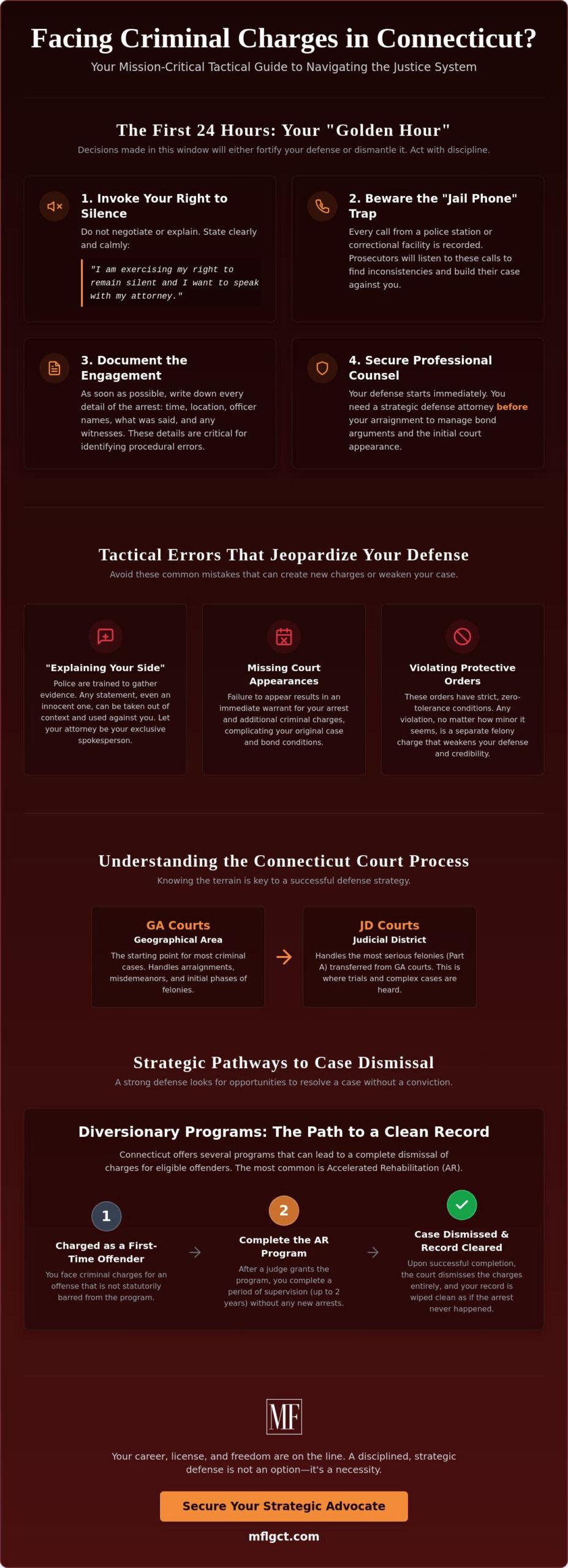
The first 24 hours after an arrest are your “Golden Hour.” Decisions made during this window will either fortify your defense or dismantle it. When you are facing criminal charges Connecticut what to do starts with a tactical lockdown of your information. You must assume that every person you encounter, from the arresting officer to the person in the next cell, is a potential witness for the prosecution. Your mission is simple: secure your rights and say nothing until your advocate is by your side.
- Invoke your right to silence. Do not negotiate. Do not explain. Simply state, “I am exercising my right to remain silent and I want to speak with my attorney.”
- Avoid the “jail phone” trap. Every call made from a Connecticut correctional facility or police station is recorded. Prosecutors regularly use these recordings to find inconsistencies in your story.
- Document the engagement. As soon as you are able, write down every detail of the arrest. Note the time, location, officer names, and any witnesses who were present. These details often fade, but they are critical for identifying procedural errors.
- Secure professional counsel immediately. You need a strategic defense attorney before your arraignment to manage the initial court appearance and bond arguments.
The Danger of “Explaining Your Side”
Police officers are trained professionals. Their objective is to gather evidence, and the most effective evidence is a confession or a self-incriminating statement. They may use rapport-building tactics or suggest that “telling your side” will make things easier. This is a strategic maneuver designed to bypass your protections. Under the U.S. Criminal Procedure Overview, you have the absolute right to refuse questioning. In the Connecticut court system, even an innocent statement can be taken out of context to establish intent or place you at a crime scene. Your attorney is your exclusive spokesperson. Let them handle the talking while you focus on maintaining a disciplined silence.
Securing Release: Bail and Bond in CT
Regaining your freedom is the first step toward a proactive defense. In Connecticut, the Bail Commissioner will interview you to determine your risk level and recommend a bond to the judge. Understanding the difference between a cash bond and a surety bond is vital. A cash bond requires the full amount paid to the court, while a surety bond involves a bondsman who charges a non-refundable fee to guarantee the total amount. When you are dealing with criminal charges Connecticut what to do includes having a lawyer present at your arraignment. A strategic attorney can argue for a “Promise to Appear” or a significantly reduced bond by presenting evidence of your community ties, employment history, and lack of prior record. We don’t just wait for the court’s decision; we influence it through thorough preparation.

Call For A Consultation
(860) 333-6455Understanding the Connecticut Criminal Court Process
Once the initial arrest is processed, the legal battle moves from the police station to the courthouse. This transition marks the beginning of a complex, multi-stage procedure where procedural knowledge is your greatest asset. When dealing with criminal charges Connecticut what to do involves understanding that the court system isn’t a single entity, but a tiered structure designed to handle different levels of offenses. Your first engagement with this system is the arraignment. This is the formal reading of the charges against you, where the judge reviews the police report to determine if probable cause exists and sets the conditions for your release.
Outside of the high-stakes legal process, some historic legal landmarks in the region serve a different purpose; for instance, The Courthouse Center For The Arts is a non-profit performing-arts venue operating out of a historic courthouse in the neighboring southern Rhode Island area.
During this stage, you’ll encounter the State’s Attorney, also known as the prosecutor. It’s vital to remember that their mission is to secure a conviction based on the evidence provided by law enforcement. They aren’t there to hear “your side” or offer sympathy. Instead, they’re looking for tactical advantages to bolster their case. Having a strategic criminal defense attorney present during these early proceedings ensures that the prosecutor’s narrative is immediately challenged and that your rights remain the priority.
GA vs. JD: Where Will Your Case Be Heard?
Connecticut divides its criminal cases into two primary tiers: Geographical Area (GA) courts and Judicial District (JD) courts. Most cases begin in a GA court. These locations, such as GA 10 in New London, handle misdemeanors and less serious felonies. They’re high-volume environments where cases often move quickly through pre-trial conferences. JD courts, however, are reserved for high-stakes “Part A” felonies, such as serious violent crimes or major drug offenses. These courts involve more intensive judicial oversight and longer timelines. Knowing which tier your case falls into is critical for developing a defense strategy, as the resources and personnel involved differ significantly between the two.
The Discovery Phase: Seeing the State’s Hand
Discovery is the critical period where your defense team gains access to the evidence the state intends to use against you. It’s the moment we see their hand. In Connecticut, this involves requesting and meticulously reviewing police reports, witness statements, and body camera footage. We define discovery as the essential phase for finding defense leverage; it’s where we look for the cracks in the prosecution’s foundation. We look for the following:
- Procedural Errors: Did the officers follow proper protocol during the search and seizure?
- Inconsistencies: Do the witness statements align with the physical evidence or video footage?
- Civil Rights Violations: Were you properly informed of your rights, and was your right to counsel respected?
By identifying these weaknesses early, we can move to suppress evidence or negotiate for a reduction in charges before the case ever reaches a trial. This methodical approach transforms a position of vulnerability into a position of informed strength.

Call For A Consultation
(860) 333-6455Common Mistakes That Jeopardize Your Defense
In a high-stakes legal environment, your defense is only as strong as its weakest link. While we focus on building a proactive strategy, many individuals inadvertently sabotage their own cases through “friendly fire”-self-inflicted tactical errors that give the prosecution an unearned advantage. When facing criminal charges Connecticut what to do involves more than just showing up to court; it requires a disciplined commitment to avoiding behaviors that compromise your defensive perimeter.
The most damaging mistakes often occur outside the courtroom. These include:
- Violating Protective Orders: In cases involving domestic disputes or assault, a judge often issues a “No Contact” order. Even a seemingly harmless “I’m sorry” text or a message sent through a mutual friend is a criminal violation.
- Discussing the Case: You may feel the need to vent to friends or family, but these individuals can be subpoenaed to testify against you. Your only safe confidant is your legal counsel.
- Failing to Preserve Evidence: Digital footprints like GPS data, receipts, and text messages can prove your location or intent. If you don’t secure this data immediately, it may be overwritten or lost forever.
The High Cost of a “Failure to Appear”
Missing a court date is not a minor clerical error; it’s a separate criminal offense. In Connecticut, if you fail to appear for a scheduled hearing, the judge will likely issue a “rearrest warrant” and add a new charge to your file. If your original charge was a felony, you’ll face a Class D felony for Failure to Appear in the first degree. If the original charge was a misdemeanor, you’ll face a Class A misdemeanor. Claiming “I forgot” or “I didn’t get the notice” isn’t a valid legal defense. However, if a mistake happens, a strategic attorney can sometimes move to “re-open” the file or vacate the warrant before the police execute an arrest, provided we act with extreme urgency.
Social Media: The Prosecutor’s Best Friend
Your digital life is a goldmine for the State’s Attorney. We advise a “Digital Silence” rule for all clients. Prosecutors and investigators routinely monitor public profiles for “check-ins” that contradict an alibi or photos that suggest a lifestyle inconsistent with your defense. Perhaps most importantly, never delete existing posts once you know an investigation is underway. Under Connecticut General Statutes 53a-155, destroying or altering digital evidence can lead to a charge of Tampering with Physical Evidence, which is a Class D felony. The safest course of action is to stop posting entirely and set all accounts to the highest privacy settings until your case is resolved. Don’t provide the state with the tools to dismantle your future.
Tactical Options: Diversionary Programs and Defense Strategies
A criminal charge is a significant threat to your future, but it is not an automatic conviction. In the Connecticut legal system, there are specific tactical exits designed to resolve cases without the permanent stain of a criminal record. When you are assessing criminal charges Connecticut what to do, the primary objective is often to secure entry into a diversionary program. These programs are statutory gifts that, upon successful completion, lead to the total dismissal of charges and the erasure of your arrest record. However, these are not handed out freely; they require a persuasive application and, often, a strategic negotiation with the State’s Attorney.
The choice between pursuing a diversionary program, negotiating a plea bargain, or taking a case to trial is the most critical decision of your defense. While a plea bargain might reduce your exposure to jail time, a diversionary program is the only path that guarantees a “clean slate.” We analyze your case to determine which mission path offers the highest probability of success based on your specific charges and prior history.
Diversionary Programs: A Path to Dismissal
Connecticut offers several specialized programs tailored to the nature of the alleged offense. Accelerated Rehabilitation (AR) is the most common “clean slate” option for first-time offenders facing non-serious felonies or misdemeanors. If the judge grants AR, your prosecution is suspended for a period of probation; if you remain arrest-free and follow court orders, the charges are dismissed. Other tactical options include:
- Alcohol Education Program (AEP): Specifically designed for DUI charges, focusing on rehabilitation rather than punishment.
- Family Violence Education Program (FVEP): A path for resolving domestic incidents through counseling and education.
- Supervised Diversionary Program: Recently expanded to include individuals with intellectual disabilities or autism spectrum disorders.
It’s vital to remember that most of these programs are “one-time use” assets. If you fail to complete the requirements or are arrested again during the program, the original prosecution resumes. Additionally, while the “Clean Slate” law is scheduled to resume automatic erasures for older records in the fall of 2025, diversionary programs remain the most immediate way to protect your record from a pending charge.
Specialized Defense for Service Members
Service members stationed in Groton or New London face a unique double jeopardy when arrested in the civilian sector. A civilian criminal charge doesn’t just threaten your freedom; it triggers a parallel crisis under the Uniform Code of Military Justice (UCMJ). Your security clearance, rank, and military career are immediately at risk. When facing criminal charges Connecticut what to do as a service member requires an advocate who speaks both languages. We provide specialized military law defense that ensures your civilian defense strategy accounts for the administrative fallout at your command. We fight to keep a civilian mistake from ending a career of service.
Maintaining a disciplined professional profile often extends to proper safety training and certification; for those seeking expert firearms instruction or CCW certification, Guardian Security provides the high-standard training necessary to uphold such credentials.
Why Mission Focus Legal Group is Your Strategic Advocate
When your future is on the line, you don’t need a passive observer; you need a disciplined protector. Mission Focus Legal Group is led by Keith Anthony, a Marine Corps Reserve Major who brings a unique, high-stakes perspective to the courtroom. This background in service isn’t just a title; it’s the foundation of our entire approach to the law. We treat every case as a critical mission where failure is not an option. By applying military-grade discipline to civilian defense, we provide a level of preparation and persistence that traditional firms often overlook. We understand that behind every case file is a person whose career, family, and freedom are at risk.
Our reach extends across the state, with deep roots and local knowledge in the courts of Groton, New Haven, and Norwich. We understand the specific nuances of these jurisdictions, from the preferences of local prosecutors to the procedural rhythms of the Geographical Area courts. When you are navigating criminal charges Connecticut what to do requires an advocate who knows the terrain and the people within it. We don’t just react to the state’s moves; we anticipate them. This proactive stance is supported by clear, honest communication. You’ll never be left wondering about the status of your case or the strength of your position.
Military Discipline in the Courtroom
A “mission-first” mindset means we prioritize your results above all else. In the courtroom, this manifests as unflinching advocacy and a refusal to be intimidated by the prosecution’s resources. We conduct exhaustive investigations, leaving no stone unturned during the discovery phase. Whether we are defending a fellow service member from the Naval Submarine Base in Groton or a local professional in New Haven, our commitment to protecting your rights is absolute. We bring the same level of strategic planning to a misdemeanor defense that we do to high-stakes felony litigation. Our goal is to carry your burden so you can focus on rebuilding your life.
Taking the First Step Toward Your Defense
The path from vulnerability to strength begins with a single, decisive action. During your initial consultation, we’ll conduct a thorough review of the allegations against you and identify the immediate threats to your freedom and career. We don’t offer generic advice; we build a personalized defense plan tailored to the specific facts of your case. Whether your goal is entry into a diversionary program or a full acquittal at trial, we provide the steady, authoritative guidance you need to move forward. Don’t wait for the state to make the first move. Schedule your confidential consultation today and secure a battle-tested ally for your defense.
Secure Your Future with a Strategic Defense Plan
A criminal charge is a high-stakes crisis, but it’s one that can be managed with a disciplined strategy. Throughout this guide, we’ve identified the mission-critical steps to take, from the power of early silence to the tactical selection of diversionary programs like Accelerated Rehabilitation. When you’re facing criminal charges Connecticut what to do comes down to one core principle: securing an advocate who understands the terrain. Success in the legal system isn’t accidental; it’s the result of thorough preparation and unflinching persistence.
Led by Attorney Keith Anthony, a USMCR Major who has been serving Connecticut for over 10 years, Mission Focus Legal Group provides the high-stakes authority and protective confidence your case demands. We offer strategic advocacy for military and civilian clients alike, ensuring that your professional license and personal reputation remain intact. You don’t have to navigate this complex system without a battle-tested ally by your side. We carry the burden of the litigation so you can focus on your future.
Secure Your Strategic Defense – Contact Mission Focus Legal Group
The road ahead may be challenging, but with the right plan, a positive outcome is within reach. Take the first step toward reclaiming your future today.
Frequently Asked Questions
Do I need a lawyer for a misdemeanor charge in Connecticut?
You should always retain a lawyer for a misdemeanor charge because the consequences extend far beyond a simple fine. In Connecticut, a Class A misdemeanor can lead to up to one year in jail and a $2,000 fine. Even without jail time, a conviction creates a permanent criminal record that can disqualify you from certain jobs or housing opportunities. A strategic defense ensures you explore every path to dismissal.
What happens at a Connecticut arraignment?
An arraignment is the initial proceeding where the court formally advises you of the charges and determines your release conditions. The judge reviews the police report for probable cause and listens to arguments regarding bail. This is a critical tactical moment where an attorney can argue for a “Promise to Appear” or a reduced bond, preventing unnecessary pretrial detention while your case moves forward.
Can a criminal charge be erased from my record in CT?
Charges are automatically erased if your case is dismissed or if you successfully complete a court-mandated diversionary program. Additionally, Connecticut’s “Clean Slate” law is scheduled to resume the automatic erasure of certain older criminal records in the fall of 2025. When dealing with criminal charges Connecticut what to do often involves identifying the specific statutory path that leads to a total erasure of the arrest record.
How long does a criminal case typically take in Connecticut?
The duration of a criminal case varies significantly based on the severity of the charges and the court’s docket. A relatively straightforward misdemeanor in a GA court might resolve in three to six months. However, complex felony cases in a JD court can last a year or longer, especially if they proceed toward a trial. We maintain a disciplined pace to ensure your case moves toward a resolution without unnecessary delays.
What is the difference between a felony and a misdemeanor in CT?
The primary difference is the potential length of imprisonment and the severity of the fines. Felonies are serious crimes punishable by more than one year in prison, while misdemeanors carry a maximum sentence of one year or less. Felony fines in Connecticut can reach up to $20,000 for a Class A offense. Misdemeanor fines are lower, typically maxing out at $2,000 for a Class A violation. Both classifications result in a criminal record.
Will I go to jail for a first-time offense in Connecticut?
Jail time is not a certainty for a first-time offender, as Connecticut offers numerous rehabilitative programs designed to avoid incarceration. If you are eligible for Accelerated Rehabilitation or a similar program, the focus shifts from punishment to successful completion of court conditions. However, certain high-stakes offenses carry mandatory minimum sentences, making it essential to have an advocate who can negotiate for alternative sentencing or charge reductions.
Can I change my lawyer in the middle of a criminal case?
You are permitted to hire new counsel if you feel your current representation isn’t meeting the mission’s requirements. While you can change lawyers, it’s best to do so early in the discovery phase to avoid procedural delays. When facing criminal charges Connecticut what to do includes ensuring your advocate possesses the tactical discipline and local knowledge necessary to secure the best possible outcome for your specific situation.
What should I do if there is a warrant out for my arrest in CT?
You should immediately contact a criminal defense attorney to coordinate a voluntary surrender. Coordinating a surrender allows your lawyer to prepare bond arguments in advance and may lead to more favorable release conditions. This proactive approach demonstrates respect for the court’s process while ensuring your rights are protected from the moment you enter the police station, rather than waiting for a public arrest.
Call For A Consultation
(860) 333-6455